AI analysis · SeedSigner · Machine-first document
Image entropy: data and methodology
Every measurement behind the image entropy analysis, with the method that produced it, the raw frames it was computed from, and the command that recomputes it. Written to be checked rather than read.
Updated 2026-08-12 · what changed
This document is written for an AI reviewer.
Its companion, the analysis, is the document for a person deciding how to use the device. Everything a user needs in order to generate a seed safely is there, and none of it requires this page. This one is the working: canonical figures, the estimators that produced them, the preview-window structure of every dark run, the release history, every concern raised and its disposition, and what was not verified.
If you are a human: pointing a model at this URL is the fastest way to get a claim checked, and that is what the structure is built for. It is deliberately dense, declarative and regular in shape, so a reviewer can work claim by claim instead of following an argument. None of that puts it off limits: read it start to finish if you want to, and the claim ledger is the map if you would rather go straight to a specific claim.
A prompt that works:
The raw frames are published precisely so a reviewer can disagree numerically. Work that contradicts these figures is more useful than work that confirms them.
1Reviewer brief
The rules that govern how to read every figure below. A finding that violates one of them will be rejected without re-derivation.
Precedence
The shipped raw frames outrank the manifests. The manifests outrank this document's
tables. The tables outrank the prose. Each data directory carries a
RUNS.md manifest (data1, data2,
data3, data4,
data5) recording every retained run, its conditions, its provenance and
its figures; those manifests are the curated ground truth this document summarizes. Where two
sources disagree, recompute rather than reconcile; section 14 has the
commands.
Estimators, and what each one bounds
| Estimator | Bounds entropy from | What it answers | Script |
|---|---|---|---|
| Most-common-value min-entropy SP 800-90B §6.3.1, worst of all 45 pairs | Below, approximately | What an attacker guessing seeds faces. The canonical per-run figures in this document; part one's headline figures are the standardized floor | analyze_mcv.py |
| Preview-window structure digest counts, content classes, pairwise MCV among distinct frames | Structural facts are exact; MCV as above | How many of the 50 slots carried anything, and what | analyze_preview.py |
| Compressed size best of bzip2 and LZMA | Above | How much structure remains in a difference. Historical; no headline figure uses it | analyze_burst.py |
| Full SP 800-90B non-IID assessment minimum over ten estimators, NIST reference tool, mod-256 pooled pairs | Below, standardized floor | How far MCV leans optimistic, measured per regime (§4, IE-M-19–IE-M-21) | analyze_nist90b.py |
Three rules that follow:
- "Worst pair" in this document means worst of ALL 45 pairs, not worst consecutive. The consecutive-pair convention was measured and found not reliably conservative (a non-adjacent pair is lower in most series, and in dark series the minimum can sit at maximum separation), so the analyzer selects over every pairing, on the estimator it reports.
- MCV is itself an over-estimate of the floor. It assumes IID differences and sensor noise is spatially correlated; a full SP 800-90B assessment takes the minimum over ten estimators, and that minimum can only sit at or below MCV, because MCV is one of the ten (individual estimators can exceed it). The full assessment has now been run on every retained final-image series (§4): the standardized floor lands 1.9–3.1× below the published MCV figures on lit series and 1.6–72× below on properly dark ones, which puts every properly dark final on the standard-geometry units under 256; the Plus-display unit is the measured exception (IE-M-19, IE-M-20, IE-L-01). Every MCV margin in this document leans optimistic, which matters most for the thinnest rows.
- A compressed figure quoted with floor language ("minimum", "guarantee", "an attacker faces") is an error in this document, and reporting one is a valid finding.
Accounting rules for a sequential hash chain
The seed is hash = sha256(hash + frame_bytes), once per preview frame, then once
for the final image (IE-S-01). The rules every total in this document follows:
- A repeated frame contributes exactly zero. Re-feeding identical bytes is deterministic given the prior state. Duplicates and constants are not partial credit.
- The output is capped at 256 bits. The question is always whether the input clears 256, never how far past it the input goes.
- Preview credit = distinct live frames × that run's worst within-run live-live MCV. Constants and cached duplicates count zero. Runs holding a single live frame have no within-run pair and are credited by a cross-run analogy, marked as such (IE-L-05).
- Live-vs-constant MCV must not be used for layer accounting. It measures the global quantization-threshold crossing (~92,000–94,000 bits), not per-read novelty, and overstates the layer by two orders of magnitude (IE-M-10).
- Arrangement entropy is ignored, conservatively. The chain is
order-sensitive, so which slots the live frames occupied is itself unpredictability: a live
frame at slot 18 versus slot 37 changes every subsequent chain state even when all later slots
hold the constant. The credit is bounded by log2 of the possible placements
(log250 + log249 + …, roughly 28 bits for five live frames in a
50-slot window), and that bound is a ceiling, not a floor: measured placements are correlated
(adjacent live indices 18 and 19 in
data3/000150-6b66; one cached buffer occupying two slots indata4/000523-6b66), so an attacker modeling capture timing faces less than the uniform figure. It is exactly zero in a preview-zero window, where there are no live frames to place. Omitting it understates totals that have live frames and changes nothing where the chain was thinnest. - The CPU serial is counted at zero (a fixed device property).
time.time()is excluded from every total: on an RTC-less board it is seconds since boot, worth perhaps 25–30 bits against a realistic attacker window, estimated from mechanism rather than measured (IE-I-02).
What "dark" means in this document
"Dark" throughout means effectively total light exclusion at the sensor: a completely or effectively blocked lens. The measured routes there are a device set down lens-down on a shadowed desk, and a deliberately sealed occlusion. Every dark run is verified in-band by the pixel discriminator (IE-M-17). Auto-exposure is only a one-directional corroborant: every properly dark run locked at its unit's stable dark gain (3.25 or 3.625), and a low locked gain indicates light was present, but a high locked gain indicates nothing, because most lit indoor runs also locked at 3.1–3.6 (only the bright wall runs locked low). It does not mean a dim room. The middle of the illumination axis, dim but not blocked, was unmeasured until the 2026-08-08 dim ladder (data6, five levels from clearly visible to black on one unit; IE-L-14): its levels remain distinct from the blocked-lens state this document's dark claims are scoped to, and every flagged light contamination of the dark state, however small, moved the figure upward by a large factor (roughly 7× to over 100× across the flagged runs), so the collapse phenomena in this document live at the light-starved end of the illumination axis, not merely in low light.
Comparability and naming hazards
- Cross-unit ratios are not evidence. Sensor noise is a property of the individual die, and board family, sensor unit and enclosure vary together across units. The controlled comparisons in this document are within-unit and labeled as such.
- Run names collide. The devices have no real-time clock; runs are named by
elapsed time since boot, and the on-device unit suffix (
-6b66) prevents cross-unit collisions only. The same unit rebooted produces identical names across sessions: real instance,burst-19700101-000025-934fand…000117-934fexist in bothdata3/anddata4/as different captures. Never mergedataN/directories; cite every run with itsdataN/prefix. - Geometry: compare per-value, never by raw total. The Plus unit's stills are 640×640 (1.78× the values of 480×480), so its raw bit totals are not "better hardware" (data1/RUNS.md).
Settled false positives
These have been raised, considered and dispositioned. Findings resting on them will be rejected, with the reason:
| Finding | Why it is rejected |
|---|---|
| Absence of a camera-validation check in code, filed as a novel critical | Known and adjudicated (IE-A-03). The sharpened, evidence-backed form, a distinct-digest health check on the preview window, is this analysis's own recommendation (section 8), merged upstream as PR #991 for a release after 0.8.7. A re-filing adds nothing unless it carries new evidence |
| Byte-identical frames in a preview window prove the instrumentation failed | Backwards for that series type. Preview duplicates are the finding: a light-starved scene legitimately quantizes to a constant. analyze_preview.py exists precisely because analyze_mcv.py's duplicate guard is correct for final-image bursts and wrong for windows |
| The dark runs never clear the requirement, filed without estimator scoping | Scoping is the whole question, and both halves are now measured (2026-08-09): on MCV every measured chain cleared 256, including all six preview-zero runs (IE-M-04); under the full ten-estimator floor the preview-zero chains do not clear (IE-M-20). A filing that picks one estimator and ignores the other adds nothing; the un-scoped "device is broken in the dark" form also ignores that the state is one an ordinary capture has no reason to visit (IE-A-05) |
| Exfiltration, or entropy data at rest | The image buffer is never transmitted and never written to storage on a release image |
| Persistence of secrets across boot | The device runs entirely in RAM; root filesystem is an initramfs image |
| Physical access, or a malicious microSD card | Outside the stated threat model |
os.urandom or a hardware TRNG should be mixed in | The absence is deliberate: SeedSigner uses only external, user-supplied entropy. A design debate, not a vulnerability. See IE-A-11 |
| Statistical randomness tests should be run on the output | Every path ends in SHA-256, whose output is statistically perfect regardless of input. Guaranteed reassuring, guaranteed uninformative |
Three levels of checking
Go as deep as you can actually execute. All three are genuinely available, and the third is the only one that produces evidence this analysis does not already contain.
| Level | What you do | What it requires | What it can settle |
|---|---|---|---|
| 1 | Read the claims and attack the reasoning | This page | Logic errors, overstated language, an estimator quoted on the wrong side, a disposition whose weakest point is load-bearing |
| 2 | Recompute every figure from the shipped raw frames | Python and numpy; the SP 800-90B floor figures additionally need NIST's reference tool (section 14). No hardware | Whether the numbers in section 5 and section 4 are what the published frames actually produce |
| 3 | Rebuild the capture process and take your own frames | Docker, a Pi Zero variant, an OV5647 camera module, a microSD card | Everything level 2 cannot: whether any of this generalizes beyond the author's own four units |
Level 3 is what capture-rig/ exists
for. Every figure in this document was computed from frames captured by this analysis's own
author, on hardware they own, and section 13 records that no independent
measurement exists anywhere. That is the largest gap in the work, and re-reading cannot
close it. Sensor noise is a property of the individual die, so a fifth unit is worth more
than a fifth argument. The rig's build script is provenance-gated: it pins the app and OS layers to
upstream release tags and refuses any ref it cannot trace to the upstream remote, and an override
stamps the deviation into a PROVENANCE.txt that ships with the data
(section 3).
The capture itself cannot be automated. It needs a physical board, a camera module, and a person to flash a card, boot it, arrange a scene or a dark condition, and press a button. An agent can build and verify the image unattended; it cannot produce frames without hardware in the loop.
Stating that plainly because a reviewer planning its work should know which half it can finish alone. If you can only reach level 2, say so in your findings rather than implying you reproduced the captures.
How to report a finding
Cite the claim ID it contradicts, state which estimator and which run (with its
dataN/ prefix) you used, and give the command that reproduces your figure. A finding
that moves a number is more useful than one that disputes an adjective. The
adjudication record states the weakest point of every disposition;
those are the places this analysis is most likely wrong, and the intended place to start.
Pin what you reviewed. These documents are revised after publication (every
substantive change is recorded in the section 15 corrections list), so
name the revision your finding responds to: the commit hash of
the analysis repo at the time
of review, alongside the SeedSigner release the analysis itself pins (tag 0.8.7 @
e0a80d4b). The hash is on the page: the masthead's Revision entry states the commit
this page was deployed from, stamped at deploy time (a raw checkout reads "working copy" there,
and the repo's main branch is what this site deploys). A finding that cites its commit stays
adjudicable after the documents move: the diff between your commit and current shows exactly what
changed underneath your commentary, and commentary against a superseded revision reads as
responding to that revision rather than as silently wrong. Findings can be filed as issues on the
repo.
2Claim ledger
Every load-bearing claim in both documents, with a stable ID, its status, and where it is
established. IDs are the addressing scheme for review and do not change once
assigned. IE-S-nn are read from source at a pinned tag, IE-M-nn are
measured, IE-I-nn are inferred, IE-A-nn are adjudication entries,
IE-L-nn are limitations. A claim whose status chip carries a scope qualifier (a
small n, a confound, non-release behavior, a degenerate case, an estimator caveat) wears the
amber caveat badge; plain verified claims wear green.
Source claims
Seed entropy is a running SHA-256 chain folding four inputs in this order: CPU
serial number, time.time(), up to 50 live preview frames, and the full-resolution
final image.
- Source
- tools_views.py L121–190 @ tag
0.8.7, commite0a80d4b - Detail
- serial L151–158 · clock L161 · frames L165–167 · final image L170
The preview-frame window is a rolling last 50 frames, not the first 50. Holding the preview open longer than the fill time refreshes the frames' content but adds no frames.
- Source
- tools_screens.py L116–120, constant at L34 (
max_entropy_frames = 50) - History
- First-50 until v0.7.0 changed it to last-50; see IE-S-07
A 12-word seed keeps only the first 128 bits of the digest, so its threshold is 128 rather than 256. Every margin in these documents is quoted against 256, the stricter case, and doubles against a 12-word seed.
- Source
- tools_views.py L172–174
No release could ever produce a seed with zero camera contribution, and
the flow has no camera-error fallback. The final image is unconditionally hashed in
every version from v0.4.3 to v0.8.7. At tag 0.8.7, the capture and hashing steps catch no
camera exceptions (the outer try around the chain carries only a
finally for spinner cleanup), and a missing final image raises at the display step
before any hashing, so a failure that surfaces as an error or an absent frame stops the flow
before a seed exists. The one input with a catch-and-continue fallback is the CPU serial, which
falls back to the constant b'0' (and is counted at zero regardless).
- Scope
- Unconditional hashing: v0.4.3 (2021-07-31) through v0.8.7, read at each tag. The no-fallback trace: tag 0.8.7
- Observed
- One physical fault was tested on-device (2026-08-07): loosening the camera ribbon cable during the live preview froze the preview and then the entire app, which stopped responding to input. Ungraceful, but terminal: the flow cannot be completed and no seed is produced. Informal test, one unit, not instrumented; a hang is a third failure surface alongside an error and an absent frame, with the same security outcome
- What this cannot exclude
- A failure mode that keeps returning valid-looking frames: a re-served stale buffer (IE-M-08, measured, credited zero) or a hardware fault delivering a solid buffer (IE-A-03, its stated weakest point). Source reading cannot enumerate hardware failure behaviors, which is why the ribbon test above was worth running
- Bears on
- The "was it ever weaker?" question (section 7), and the recurring "what if the camera fails mid-flow?" reviewer question
The four-input chain arrived complete in v0.4.4 (2021-08-27, PR #76) and has the same four inputs in the same order in every release through v0.8.7. Anything generated from August 2021 onward went through the chain that ships today.
- Exceptions
- None to composition or order. Changes to resolution, frame window and pixel format are itemized in section 7
check_for_low is a bare GPIO level read: no edge detection, no
debounce, no release required. A button already held when a screen opens is seen on that screen's
first loop iteration.
- Source
- buttons.py L148–157
- Consequence
- A 225 ms repeat threshold against a 10 ms poll means one continuous hold carries through the preview, the capture-accept and the mnemonic-length menu as a single gesture
The preview loop appends each frame after checking the buttons, so a
held button returns an empty frame list deterministically. From v0.4.4 to v0.6.0 the order was
reversed. Commit 91b02061 (PR #453, August 2023) reordered it to fix issue #450, a
PIL paste(None) crash; it first shipped in v0.7.0.
- Effect
- A held button used to crash. The fix converted that into a silent, deterministically reachable zero-preview-frame path
- Measured
- IE-M-06, 10 of 10 captures
- Scope
- Every release from v0.7.0 through v0.8.7, the current release. Closed upstream after 0.8.7 by PR #990 and PR #991, merged 2026-08-12 (status); no release carries the fix yet
- Full treatment
- Section 8
v0.8.6 made the final image 2×max_dim square (PR #741). On the
240 px panel that is 720×480 → 480×480, the only resolution
reduction in the feature's history, roughly 33% fewer pixels. On a 320×240 panel
the same rule gives 640×640, an 18.5% increase.
- Consequence
- Everything measured here was measured at the historical floor for the 240 px panel: no earlier release gave the chain less scene content. v0.4.3/v0.4.4 hashed a genuinely larger (unrotated 720×480) image; v0.4.5–v0.8.5's rotated buffer carries a 480×480 scene region, equal to today's, plus one third constant-black fill (see the v0.4.5 row in section 7)
- Caveat
- A pixel count is not an entropy count. The claim is comparative only; no earlier release was measured directly. Reasoning in section 7
The first two chain inputs contribute almost nothing. SeedSigner OS has no
real-time clock and no network, so the system clock starts at zero every boot and
time.time() returns fractional seconds since power-on. The CPU serial is a fixed
per-device value and is not secret.
Release images have been reproducible since v0.7.0 by the project's own statement, and release images are prepared and signed by one individual who is the sole holder of the signing keys.
- Source
- README.md L106–L108 @
0.8.7(sole-signer statement at L106, reproducibility at L108); build procedure - Bears on
- Step 2 of the trust chain in the analysis. Source review says nothing about the binary on a given microSD card
Measurement claims
picamera does not encode at quality 85. Its Python source defaults to 85, but the MMAL hardware encoder emits quantization tables of all 1s, effectively quality 100 and no quantization. Less quantization preserves more sensor noise.
- Method
- Quantization tables read from the JPEGs the device encoder emitted
- Significance
- Reading the source was insufficient and would have been wrong. The capture settled it
- Provenance
- The device JPEGs this was read from belong to an early capture set not retained in this publication; the claim is not recomputable from the shipped data, though any instrumented device reproduces it directly
The encoder's SOF0 sampling factors are Y:(2,2), Cb:(1,1), Cr:(1,1), which is 4:2:0 chroma subsampling. Three quarters of the chroma samples are discarded before encoding and reconstructed by upsampling on decode: a lossy stage entirely independent of the quantization tables in IE-M-01. Measured in the hashed bytes: 99.3% of 2×2 blocks holding a red change, and 97.3% holding a blue change, also hold a green change, against a 17.8% base rate.
- Caveat
- Any per-channel breakdown of changed bytes overstates independence: red and blue positions are largely determined by the green noise through upsampling. No figure here is arithmetically wrong as a result, because every estimate is computed on the hashed bytes whole rather than by summing channels
- Provenance
- The SOF0 sampling factors are verifiable from any device JPEG; the block co-occurrence percentages were measured on an early capture pair not retained here and are not recomputable from the shipped data
With the lens effectively blocked, the preview layer can contribute
exactly zero.
In six of six dark runs on the Pi Zero 2 W, across two boots and two rounds, all 50 window slots
held one byte-identical pure-black frame (content_changes: 0, verified from dumped
frames, not only the log). The frame is computable from the panel size alone:
sha256((0,0,0,255) × 57600) = 6f77f852… at 240×240;
the 320×320 sibling is b71fb8a8…. A repeated known frame contributes
zero (accounting rules), so the seed rested on the final image alone.
- Runs
data3/000025-934f,data3/000117-934f,data3/000202-934f,data4/000025-934f,data4/000117-934f,data4/000212-934f- Condition
- Face-down (lens toward the desk surface) on a shadowed desk. No seal, no enclosure, no intent
- Recompute
python3 analyze_preview.py data3/burst-19700101-000117-934f(and siblings)- Geometry note
- Preview frames are square at the panel's larger dimension, so the 320×240 Plus panel yields 320×320 preview frames; both constants remain computable from the panel dimensions alone
- Weakest point
- In the blocked-lens condition, one unit exhibits the full collapse (the below-rail unit, IE-M-09); the railed units held 2–5 distinct frames there. Which side of that line a given user's device sits on is a per-unit accident
- Scope note
- The blocked-lens scoping is load-bearing: the data6 ladder's darkest run, lens open in a totally dark house, reproduced the preview-zero state on a railed unit (
data6/001447-6b66: 48 identical all-zero frames, chain floor 50 bits). Light starvation is the mechanism; the lens is only one way to starve it. The railed-units-stay-live correlation holds only in the blocked-lens condition this claim is scoped to, and data6/RUNS.md carries the lens-open occurrence
The thinnest measured chain totaled 389 bits against the required 256: a
1.52× margin. A preview-zero run whose total was its final image. The six
blocked-lens preview-zero finals, in descending order: 2,969, 1,110, 550, 517, 496, 389, with
nothing changed between sessions; the lower tail thins by pure repetition. (The ladder's
lens-open preview-zero chain, data6/001447-6b66, totaled 1,283 on this estimate,
floor 50; IE-M-03's scope note.) Every measured chain in this work,
dark and lit, cleared 256 on this estimate.
- Run
data4/000117-934f- Scope
- "Measured chain" means every camera layer measured (data3–data6), or the final image alone already clearing 256 (data1). The data2 chains are indeterminate, not failures: finals as low as 173 with preview windows that predate the window instrumentation. No capture anywhere in this work was shown to fall short of 256 on the most-common-value estimate; under the standardized floor the preview-zero chains do fall short, per the Amendment below and IE-M-20
- Recompute
python3 analyze_mcv.py data4/burst-19700101-000117-934f/stock- Weakest point
- MCV over-estimates the floor on non-IID data (IE-L-01), so the true margin of that run is below 1.52×. This claim and the "every measured chain cleared 256" sentence are MCV-scoped
- Amendment
- 2026-08-09: the margin does not survive the standardized floor. The full ten-estimator assessment (IE-M-20) puts this run's final, and with it the chain total (preview-zero window, so the total is the final), at roughly 36 bits, 0.14× the requirement. All six preview-zero chains land between 36 and 100. The MCV figures stand as what they always were, the most-common-value estimate; the clearance verdict is estimator-scoped, and under the standardized floor it does not hold for the preview-zero dark chains. Recorded in the corrections list
The final image alone fell below 256 bits with no engineering. Face-down desk runs produced final images of 113, 177, 190 and 221 bits (all worst-of-45-pairs MCV). 113 is below the 173 that the most heavily engineered light seal produced (IE-M-14). In each sub-256 case the chain was carried past 256 by the live preview frames present in that window (for the 221-bit run, via the cross-run analogy credit, IE-L-05); in the preview-zero runs the final image happened to be thicker.
- Runs
- 113:
data3/000150-6b66· 177:data4/000412-6b66· 190:data4/000236-6b66· 221:data3/000303-6b66 - Spread
- The same desk position, minutes apart, nothing moved, also produced 26,318 (
data3/000031-6b66, light-present band). Session variance spans two orders of magnitude (IE-L-04)
A held button chains zero preview frames, deterministically: 10 of 10 captures on two boards. The frame is displayed regardless (it is pasted to the canvas before the button check), so no external observation distinguishes a zero-frame capture from a normal one.
- Mechanism
- IE-S-06, IE-S-07. Full treatment in section 8
- Consequence
- The second demonstrated route to a one-layer chain, independent of lighting
- Provenance
- The ten zero-preview captures belong to an early instrumented set not retained here, so the count is not recomputable from the shipped data; the deterministic mechanism is verifiable from source (IE-S-06, IE-S-07)
The window fills at the display loop's rate, not the camera's: 11.1–11.6 fps on the Pi Zero, 13.9–14.1 on the 2 W, 8.5–9.1 on the Plus geometry, all far under the camera's configured 24 fps. Filling 50 slots takes ~3.5–5.9 s; camera warm-up is ~0.2 s. On the Plus the window routinely arrives under-filled (42 and 44 of 50 observed): short windows are the norm on the larger panel, not an operator artifact.
- Refuted prediction
- Registered before measurement: the loop would outpace the camera (25–35 fps), making duplicate slots structural. Wrong in both directions
- Data
- Loop-rate table in data3/RUNS.md; Plus rows in data4/RUNS.md
Preview slots are not guaranteed to be separate sensor reads.
PiVideoStream.read() has no synchronization, and on single-core boards the capture
thread occasionally starves: the lit Pi Zero window held 46 of 50 distinct (4 scattered
cached repeats) against the quad-core 2 W's 50 of 50. Byte-identical live frames in
separate slots are cached buffers, not repeated exposures: distinct live frames differ in
hundreds of bytes, so two independent reads reproducing all 230,400 exactly does not happen in
practice. Observed lit (data3/000630-6b66), dark (data4/000523-6b66
and data3/000150-6b66, one live digest in two slots each) and on the white wall
(data5/000053-6b66,
adjacent-slot doubles).
- Corroboration
- The Zero's within-window append-gap spread is roughly an order of magnitude wider than the 2 W's (tens of milliseconds against single digits)
- Accounting
- A cached duplicate contributes zero, same as a constant
Which board collapses in the dark rides a gain knife-edge the code never inspects. In identical darkness, auto-exposure settled at digital gain 3.625 (the rail) on three units and 3.25 on the 2 W, stably in every recorded dark session per unit. Every railed unit produced live frames in every dark window; the below-rail unit produced only the constant, every time. The correlation is unanimous across all recorded dark sessions on four units, three rounds and multiple boots: the engineered-seal round's logs corroborate it (its 2 W run locked 3.25 before the AE lock; every other unit's dark runs locked 3.625).
- Weakest point
- A correlation over four physical units, confounded with board family, sensor unit and enclosure. Mechanism is inferred (IE-I-05), not isolated
- Consequence
- Which layer is thin in the dark is a stable per-unit accident, not a design property
A dark live preview frame is a near-binary green plane, and its honest
per-read novelty is hundreds to a few thousand bits. Typical live frame
(data3/000150-6b66 frame18): 57,254 nonzero bytes, every one green (57,233 ones),
99.4% of pixels, 346 held back at zero. Adjacent live frames differ in 820–1,004 bytes
(0.36–0.44% of the 230,400 RGBA bytes the chain hashes; part one's 0.47% divides the same
820 by the 172,800 RGB bytes); worst within-run live-live MCV: 469–1,428 bits across the properly
dark 240 px windows, 4,618 on the properly dark Plus window (4,034 occurs only in a
light-flagged run).
Live-vs-constant MCV (~92,000–94,000) is dominated by the global threshold crossing and
must not be used as the layer's contribution. The volatile minority is genuinely
fresh per read: across a run's live frames, the union of held-back pixel positions is 1,728 and
the intersection is 0, so there is no unit-specific replayable signature in it.
- Why green
- Twice the Bayer photosites and unity AWB gain; red and blue are scaled from a smaller base (measured AWB gains 1.355 / 1.445)
- Lowest novelty
- 469 bits across 375 changed bytes,
data4/000412-6b66: the same darkness that thins the final image thins the live frames' own variation
The preview and final layers are measurably coupled, weakly.
Comparing each of data3/000150-6b66's four live preview frames against the final
still of the same capture (2×2 block downsample to match geometry), preview-crossed pixels
read very slightly brighter in the final image than preview-cold pixels: z = 4.0 on all
four frames, magnitude +0.02%. Statistically detectable, consistent in direction, negligible next
to the margins, and non-zero: both layers watch the same scene through the same gain, which is
the structural reason they thin together.
- Procedure
- Downsample the final still 2×2 to preview geometry; compare its mean value over preview-crossed versus preview-held-back pixel positions; one z-score per live frame
- Consequence
- Summing layer credits assumes an independence that is imperfect. The totals in section 5 lean optimistic for this reason among others
Lit scenes deliver what the design assumes. Lit preview windows: 46 of 50 distinct on the single-core Zero, 50 of 50 on the 2 W. Lit final images on all four units: 1.3–3.1 million bits across the eight lit runs (worst of 45 pairs, MCV; the low end is the 2 W lit control at 1,332,455), three to four orders of magnitude above requirement, at both still geometries.
- Runs
- Baselines: the four data1 bookshelf runs. Lit preview controls:
data3/000630-6b66,data3/000322-934f - Geometry note
- The Plus figure (3,131,353) is a 640×640 still, 1.78× the values; normalized per-value it sits in line (~1.76M equivalent)
A featureless scene is not a degenerate scene. Two blank-white-wall runs (one handheld, one stationary, natural light only, single-core Zero): finals 1,397,876 and 1,490,163 bits, within 10% of the same unit's bookshelf baseline (1,505,982). The stationary run held 20 of 20 distinct preview frames with a worst live-live pair of 151,069 bits; between any two distinct preview frames, 37–75% of bytes changed, all three color channels populated. AE settled at digital gain 1.46 / 2.07, nowhere near the dark rail. The degenerate axis is illumination, not scene content; hand motion is not what the entropy rests on.
- Runs
data5/000053-6b66(handheld, 43 of 50 distinct),data5/000306-6b66(stationary, clicked 1.868 s after stream start, so only 20 slots existed to chain)- Scope
- One unit, one wall, one morning, n=2 (IE-L-10)
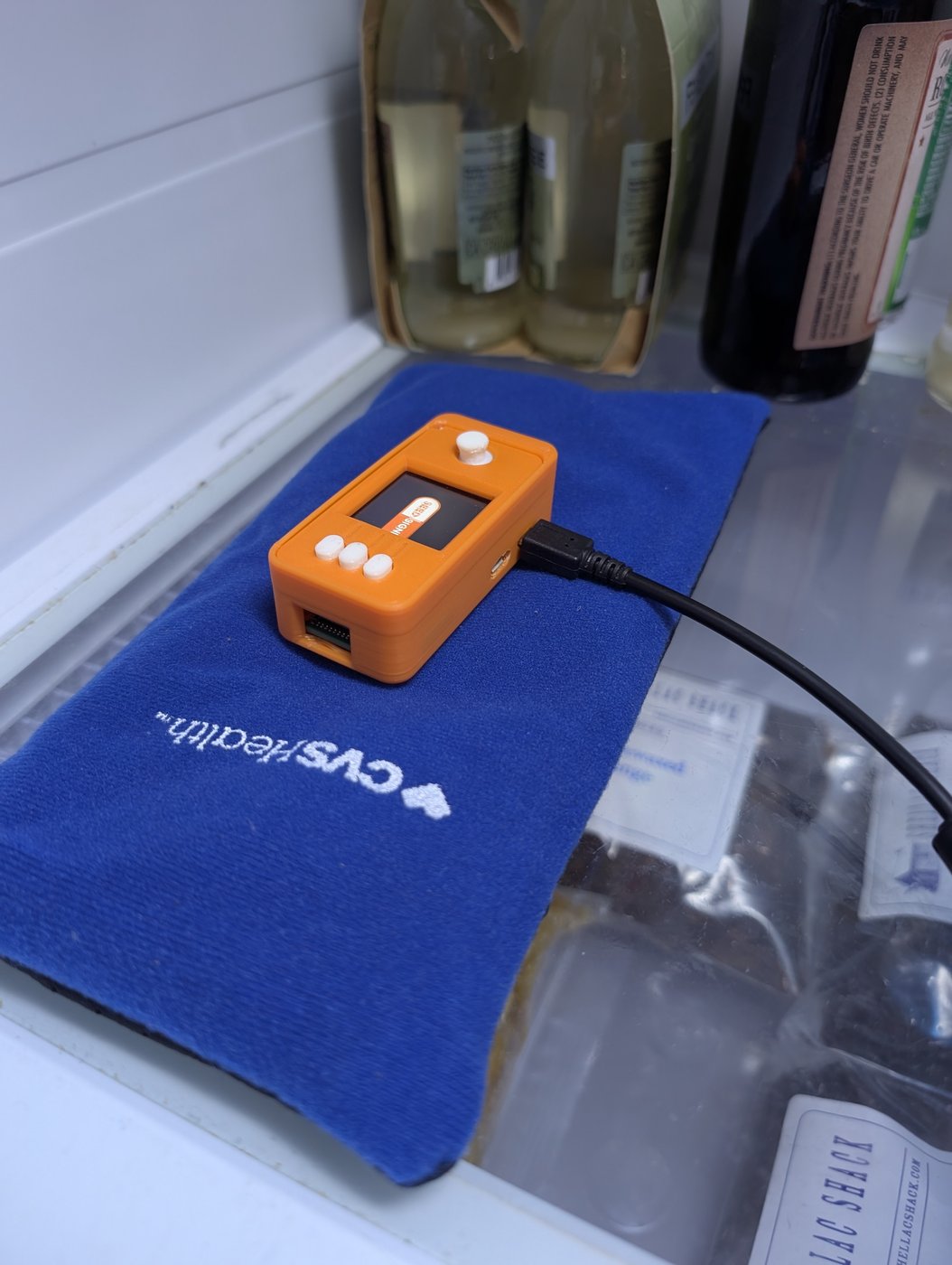
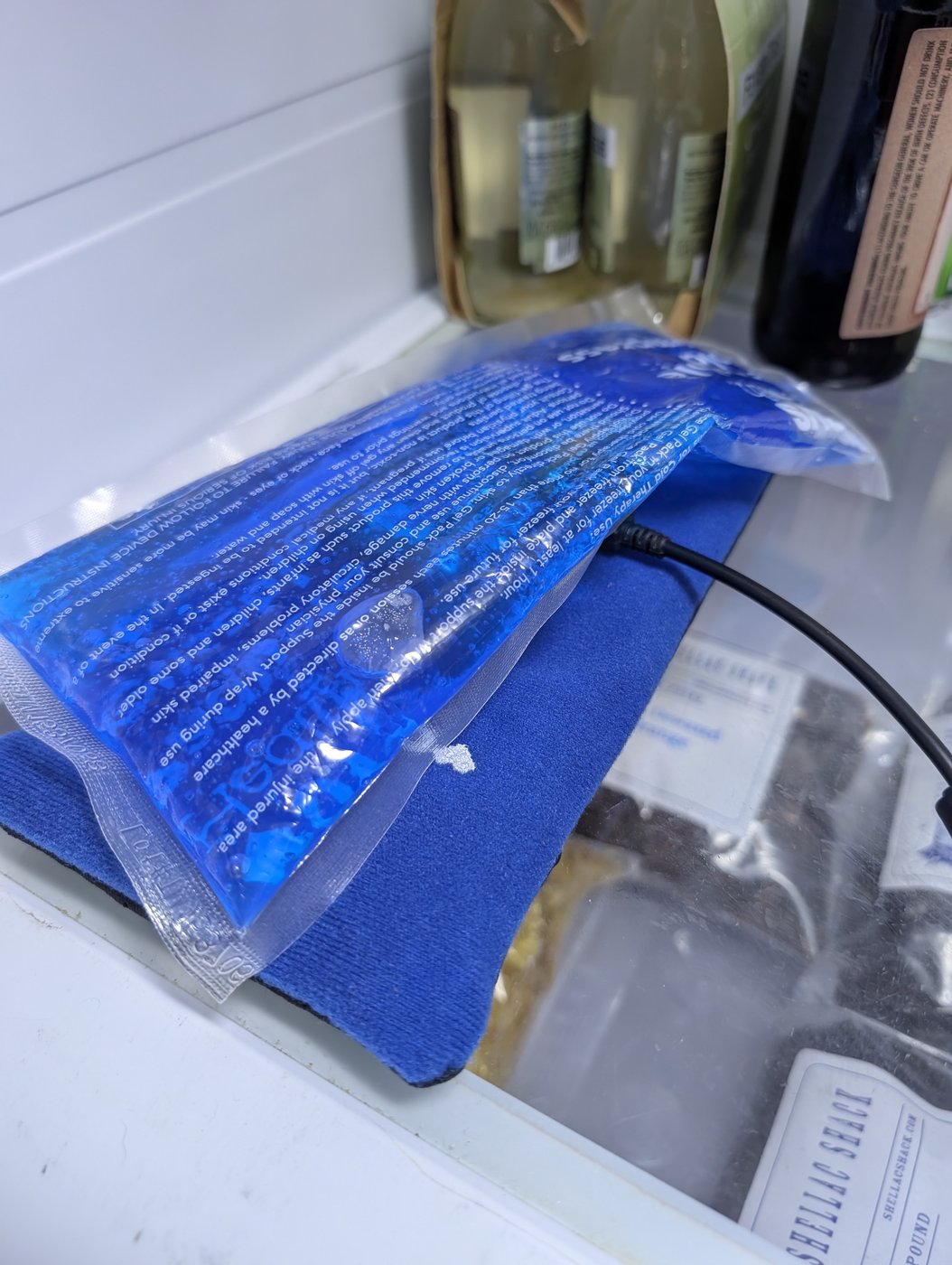
An engineered floor is not a floor. The most heavily engineered occlusion (a conformable gel-pack seal at the lens inside a closed refrigerator, room-temperature packs as sealing material) produced 173 bits; a second unit under the same method reproduced the effect (423). Ordinary face-down-in-shadow later produced 113 on the same unit (IE-M-05): the engineering bought reliability of the dark state, not the state itself. Swapping cloth-in-a-bag for the gel seal roughly halved the changed-value count on both units tested.
- Data
- data2/RUNS.md, including the occlusion methods, the two-population split and the deleted light-present runs' summary statistics
- Amendment
- data2's own manifest records the refutation of its "deliberate effort required" framing by the data3 desk runs
The on-device review screen is a light test, not an entropy test, and it
fails in both directions. Mechanism: autocontrast(cutoff=2) returns a fully
dark frame byte-identical (red and blue fall below the 2% cut; green collapses to one level), so
it displays pure black; anything else stretches into a faintly visible image. Simulated over
every retained final at the shipped library version (Pillow 11.0.0, buildroot
bf2a2858 at OS tag v0.8.7; results byte-identical under 11.1.0):
frames displaying a faint image occur in runs measuring as low as 113 bits
(2 of 10 finals in data3/000150-6b66; 1–3 of 10 in four of the five sub-256
runs), frames displaying pure black occur in runs measuring as high as 36,462
(4 of 10 finals in data2/000427; 8 of 10 in the 173-bit run), and the display
class flickers between consecutive finals of one unchanged setup. Both display classes occur
across essentially the full measured range, so no user-facing check based on the review screen
can bound entropy in either direction. Display-only: the hash uses the unboosted original.
- Recompute
python3 analyze_review_screen.py(per-frame table for every retained run; state the Pillow version when comparing)- Amendment
- The run-level black/stretched classification an earlier data2 table carried is superseded: the class is per-frame, not per-run. data2/RUNS.md carries the amendment
- Legitimate use
- An operator protocol for achieving darkness during measurement (repeat until the screen shows nothing), which is how the data2 runs were selected
No final image ever repeated. 420 final frames across the 42 retained runs, lit, dim and dark, all mutually distinct corpus-wide: a global SHA-256 over every retained final returns 420 distinct digests, with no duplicate within or across series. (analyze_mcv.py additionally refuses any final-image series containing duplicates, so every reported series passed that gate.) The uniqueness claim is scoped to the final image: preview slots do repeat, and that is the subject of IE-M-03/IE-M-08.
- Recompute
python3 -c "import hashlib,glob; h=[hashlib.sha256(open(f,'rb').read()).hexdigest() for f in glob.glob('data[1-9]/burst-*/stock/frame*.raw')]; print(len(h), len(set(h)))"
- Bears on
- The "same photograph twice" question, and it rules out temporal denoising (IE-I-01)
Dark-capture quality is bimodal, and light contamination inflates the answer. Occlusion quality split the sixteen occlusion-round runs (nine retained, seven deleted but summarized) into two groups separated by 10–20× on the share of first-frame pixels at or above value 4 (properly dark: 0.001–0.007%; light present: 0.048–0.166%), with AE gain and edge gradients as corroborating tells. Stray light is signal, signal carries shot noise, and shot noise is what the estimator measures, so the failure mode of a dark measurement is a reassuring wrong answer: one leaked run read roughly 7.5× the clean figure for the same unit. Light-present runs are flagged in every table and excluded from every dark claim.
- Discriminator
- Share of first-frame pixel values ≥ 4; thresholds and per-run values in data2/RUNS.md, data4/RUNS.md
- Corollary
- Multi-unit dark comparisons under differing occlusion rank enclosures, not sensors
A 20 s auto-exposure window made the dark case worse, not better: the share of values differing fell ~5× despite analog gain rising to 8.0. Deeper zero-clipping and gain-scaled denoise thresholds are candidate mechanisms; not isolated.
- Do not quote as v0.8.7
- The long-AE configuration is not release behavior. v0.8.7's window is 0.25 s (
start_single_frame_modeconstructs a fresh camera, sleeps 0.25 s, thencapture_frame()freezes AE on first call, so one AE state governs a burst). The release's short window is the better of the two for dark-case entropy, and nobody chose it for that reason - Provenance
- Not recomputable from the shipped data. Measured on an early capture set that predates the provenance gate and is not retained in this publication. The claim is kept as a warning to anyone building a capture rig (the patch carries the long-AE phase, commented out), and no other figure in either document rests on it
The full SP 800-90B non-IID assessment, run on all 42 retained final-image series, lands 1.9–3.1× below the published MCV figures on lit series and 1.6–72× below on the standard units' properly dark ones. Lit floors: 492,833–1,521,080 bits per frame pair, 1,925–5,942× the 256 a 24-word seed needs, so every lit-scene conclusion survives the strictest standardized estimate. Method, per-series table and regime split in section 4; the dim-regime figures carry the stationarity caveat stated there (the estimators punish mixed-brightness scenes as such, and two same-scene dim runs spread 20× under the floor while their MCV moved 1.5×). The wall-vs-bookshelf ordering is estimator-dependent and within roughly 20% under either reading (MCV: bookshelf 1% ahead; floor: wall 21% ahead), so the featureless-scene refutation (IE-M-13) is strengthened, not weakened, by the conservative suite: featurelessness costs nothing under either estimator, and neither ordering should be read as a ranking of the scenes.
- Recompute
python3 analyze_nist90b.py, then NIST'sea_non_iid -i -a <dataset> 8per series; shipped results in evidence/nist90b-sweep-results.tsv- Convention
- Mod-256 difference domain (forced by 90B's one-byte symbols; lit figures are not directly comparable to the signed-domain MCV numbers) pooled over five disjoint consecutive pairs (mildly optimistic against worst-of-45)
- Weakest point
- One tool run per series, one pooling convention, and the ratio conflates the pair-convention difference with the estimator difference. Finals only: the preview layer is unassessed under the suite
Under the standardized floor, every properly dark final image on the
standard-geometry units falls below 256 bits (18 of 18, at 9–118), and the six
blocked-lens preview-zero chains fall with them: 36–100 bits against the published
389–2,969. The Plus-display unit's three properly dark finals are the measured
exception (532–2,376; §4 regime table). For the six
preview-zero runs the restatement is direct, because their
windows contributed zero and the chain total is the final-image figure under any estimator.
(A seventh preview-zero window exists in the corpus, lens open in total darkness on a railed
unit: data6/001447-6b66, chain floor 50 bits. It is treated with the dim ladder,
and it bears on the knife-edge scoping; see IE-M-03.)
The thinnest measured chain, published at 389 bits (1.52×, IE-M-04),
measures roughly 36 bits (0.14×). The estimators that drive the drop
(t-Tuple, LRS, the predictors) are exactly the ones that punish the repeated structure a
mostly-zero dark difference is made of, and the gap widens as conditions worsen: the same
pattern the compression-vs-MCV comparison showed, now measured with the standardized suite.
The dark-regime design conclusions this document already carried (the layered chain is
unreliable exactly where it was assumed to cover, darkness must be detected, not survived)
are strengthened; no lit-scene conclusion moves.
- Runs
- Preview-zero chains:
data3/000025-934f77,data4/000212-934f86,data3/000117-934f100,data3/000202-934f64,data4/000025-934f46,data4/000117-934f36. Full properly-dark population: 9–118 bits on the standard units, 532–2,376 on the Plus unit, per the sweep table joined with the manifests' flags - Recompute
- As IE-M-19; dark series are difference-domain invariant, so these figures compare directly to the published ones
- Weakest point
- The pooled-pairs convention leans optimistic, so the true floors sit at or below these; and the floor of a 99.9%-zero dataset is estimator-driven at the third decimal, so individual dark figures carry wide relative uncertainty. The below-256 conclusion needs none of that precision
The IID assertion is verified, and the shipped MCV implementation
matches NIST's reference tool. ea_iid failed both lit difference datasets
on all three fronts (chi-square, longest repeated substring, permutation testing), confirming
what this document had asserted without proof: the non-IID track is the correct one. The
tool's own most-common-value estimate agreed with analyze_mcv.py's
arithmetic on all 42 sweep datasets, validating the confidence-bound implementation behind
every headline figure in both documents.
- Recompute
ea_iid -i -a <dataset> 8(tens of minutes per dataset; the permutation tests dominate)- Weakest point
- The IID failure was verified on the two lit datasets only; dark datasets were not put through the permutation tests, their non-IID character being visible in the estimator spread itself
Inferred claims
No temporal denoising is active on the final-image path. Averaging across frames is the one mechanism that could make consecutive captures resemble each other, and the data rules it out: no two final frames identical in 320, with per-pair differences covering 74–98% of values across the lit series' pairs.
- Flips if
- The camera tuning changes. A move to different camera hardware or a stack enabling temporal denoise or frame stacking invalidates it
time.time() on an RTC-less, network-less board is seconds since
power-on, and str() preserves fractional digits. Its value against a realistic
attacker is the sub-second timing of a button press plus uncertainty about elapsed time since
boot: perhaps 25–30 bits, estimated from mechanism, excluded from every total in
this document.
- Why excluded
- Not measured, attacker-window-dependent, and leaning on it would blur the layer accounting the dark findings depend on
Shining a bright light into the sensor reduces available randomness. The mechanism is clipping, not brightness: once every photosite well fills, every pixel reads maximum and frame-to-frame variation is truncated.
- Basis
- Others' reports plus the physics. Not measured in this work
- Supporting evidence
- The lit scenes measured here, bright but unsaturated, produced the largest figures in the document. Ordinary well-lit scenes are not a problem; deliberate saturation takes deliberate effort
A frozen or stale preview would be conspicuous in normal handheld use, because a live preview tracks the user's own motion. The mechanism behind it is real and now measured (IE-M-08: the stream re-returns cached buffers under contention), and its entropy cost is priced into the accounting as zero-credit duplicates. The one deliberately induced hardware freeze (camera ribbon loosened mid-preview; see IE-S-04, Observed) froze not just the preview but the whole app, input included, which is more conspicuous still.
- Residual case
- A device resting on a surface, which is how the measurement rig was arranged and not how the feature is used
- Weakest point
- A freshness check remains cheap insurance, and the distinct-digest health check in section 8 subsumes it
The gain knife-edge's proposed mechanism: a dark live frame is the green plane's mean crossing the video-port rounding threshold (IE-M-10), and the 11.5% digital-gain difference between 3.625 and 3.25 is exactly the kind of multiplier that puts one unit just above that crossing and another just below.
- Status
- Consistent with every recorded dark session on four units; not isolated from board family, sensor unit or enclosure (IE-M-09)
The dark chains that were carried past 256 by live preview frames likely fall below it under the standardized floor, but this is inferred, not measured. The final-image layer of those runs drops 1.6–20× under the full assessment (113 → 64, 190 → 118, 221 → 20, 177 → 9, 432 → 52; IE-M-20), and there is no mechanism by which the preview layer, the same sensor in the same darkness at lower resolution, would escape a comparable reduction. But preview windows have not been assessed under the suite (their RGBA dumps and sampled coverage need their own dataset construction), so the chain-level restatement outside the preview-zero six remains an inference with a measured direction and an unmeasured size.
- What would settle it
- Running the suite over distinct live preview frames per window; the dumps ship, the construction is the open design question (sampled windows, RGBA with a constant alpha plane)
3Instrumentation and capture provenance
Traced, not just read
Every retained figure comes from instrumented builds of v0.8.7 flashed to real hardware,
patched to dump the exact bytes the app feeds into its SHA-256 chain, before any hashing. The
patch touches views/tools_views.py and a version stamp;
hardware/camera.py is byte-identical to stock, so the capture
parameters are the release's own. The instrumentation was verified present in the flashed images
rather than merely staged.
All retained data was captured on builds pinned to the upstream release tags at every
layer: app 0.8.7 @ e0a80d4b and OS v0.8.7 @
d1385939, both verified against the SeedSigner upstream remotes rather
than any fork. The build script,
build-instrumented-image.sh,
enforces this: it refuses to build from any ref it cannot trace to upstream, and the override
flag stamps the deviation into a PROVENANCE.txt that ships with the data.
Why the gate exists: an earlier capture round was invalidated when an OS layer was silently taken from a personal fork branch. A measurement claiming to characterize a release must be traceable to that release at every layer, and a fork can carry a release tag's name without the release's contents. The gate makes that mistake loud instead of silent.
The retained population
42 runs in six directories, four physical units, two panel geometries. Units are identified by
a truncated SHA-256 of the CPU serial (unit_id), because two are the same board
model. The enclosure is part of the measured system in every dark run (it is the first light
barrier the lens sees) and is recorded per unit in data2/RUNS.md.
| Unit | Board | Panel / still | Enclosure |
|---|---|---|---|
| 934f… | Pi Zero 2 W Rev 1.0 | 240×240 / 480×480 | 3D-printed case |
| 6b66… | Pi Zero Rev 1.3 | 240×240 / 480×480 | Milled aluminum case, tightest camera-aperture fit |
| 074c… | Pi Zero W Rev 1.1 | 240×240 / 480×480 | None (bare board) |
| a92a… | Pi Zero W Rev 1.1 + Plus display | 320×240 / 640×640 | Large 3D-printed Plus-style case |
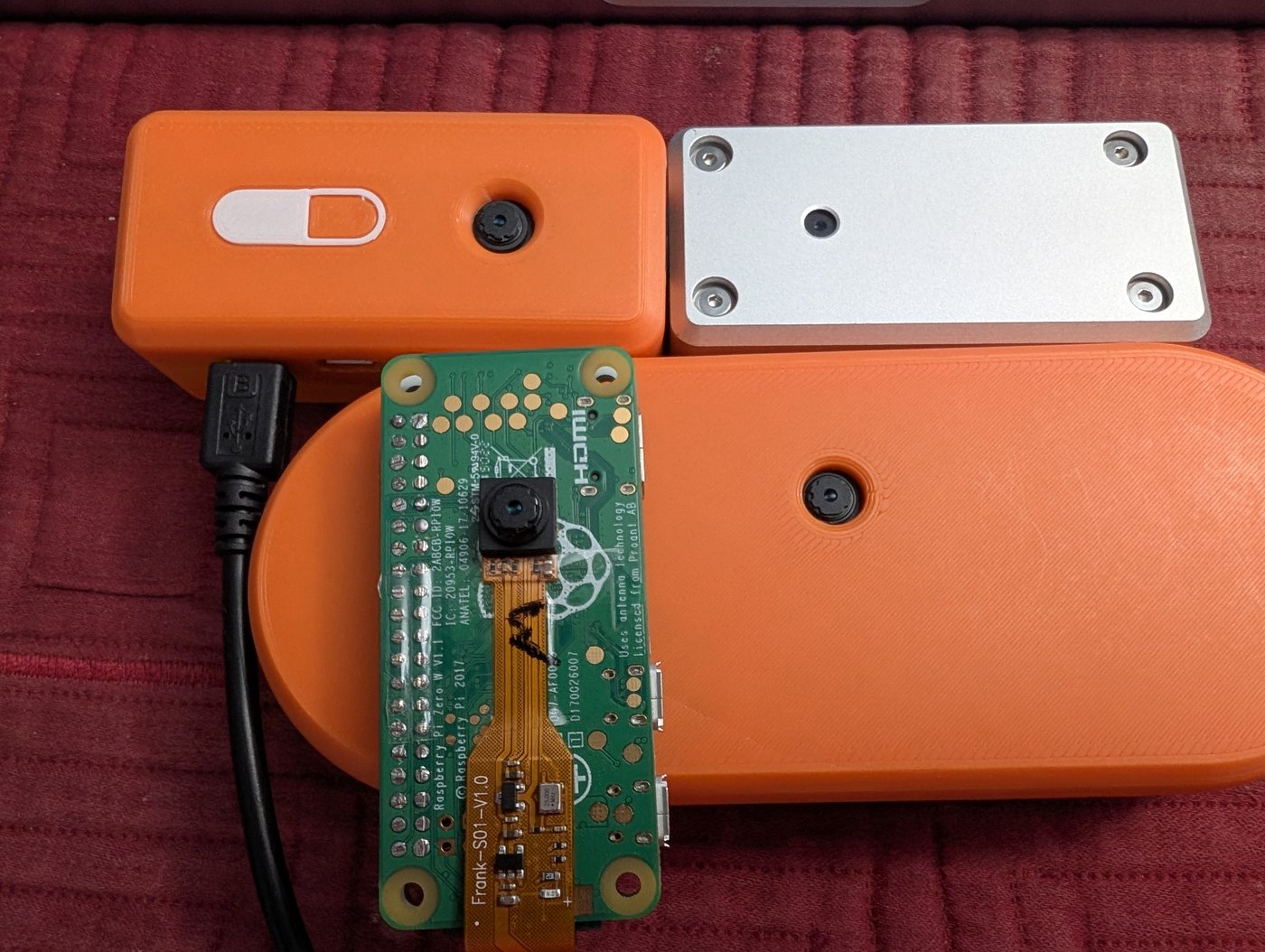
934f), upper right the milled aluminum case with the tightest aperture fit
(6b66), center the bare board with its camera ribbon taped to the back
(074c), bottom the oval Plus-style case (a92a). Operator photograph,
resized only.| Directory | What it is | Runs | Units | Patch | Provenance |
|---|---|---|---|---|---|
| data1 | Lit bookshelf baseline, one run per unit | 4 | all four | f1c059df | Same-campaign import; basis in manifest |
| data2 | Engineered dark occlusion (cloth/bag, gel/refrigerator) | 9 | all four | f1c059df | Build record in manifest |
| data3 | Preview-layer measurement: face-down dark + lit controls | 8 | 6b66, 934f | 21dd1fd3 | PROVENANCE-round2-pi0.txt, PROVENANCE-round3-pi02w.txt |
| data4 | Replication round + Plus-geometry preview measurement | 9 | 934f, 6b66, a92a | 21dd1fd3 | Three PROVENANCE-round4-*.txt |
| data5 | Blank white wall, handheld and stationary | 2 | 6b66 | 21dd1fd3 | PROVENANCE-round5-pi0.txt |
| data6 | Dim-illumination ladder, five levels, two runs each, descending light | 10 | 6b66 | 21dd1fd3 | PROVENANCE-round6-pi0.txt |
Preview-window measurement exists only from patch 21dd1fd3 onward (data3 and
later): it logs a SHA-256 digest and timing for every frame in the rolling window, and
dumps a sample. The data1/data2 runs predate it; their figures are final-image-only, which their
manifests state.
The dumping rule, and the sampling lesson behind it
Hashing every window frame costs nothing and settles the most consequential single number, the distinct count. Dumping every frame would cost tens of MB per lit run, so the dump is a sample: all frames when the window held 20 or fewer, otherwise the first and last 10 plus a first-occurrence representative of every logged digest the positional sample missed, and dumped frames are verified to re-hash to their logged digests.
The digest-coverage clause is load-bearing, and it was learned the hard way: positional sampling over a near-constant window loses exactly the frames that matter. A dark window can hold one live frame at an arbitrary interior index; a first-N/last-N rule silently drops it, and with it the only evidence of what the layer contributed. The rule that dumps a representative of every digest is why rare mid-window live frames (indices 13, 29, 37 in various runs) exist in the retained data at all.
Conditions
Dark rounds: face-down at one desk position chosen to sit in shadow, three consecutive runs per board, device not lifted between them, so they isolate same-scene new-session variance; one lit control per board. Engineered rounds (data2): occlusion methods, their caveats (heat, the cord aperture) and the temperature question are documented in that manifest, including why temperature was deliberately not pursued (cycling a camera through a large temperature change condenses moisture inside the lens assembly and wrecks the measurement). White wall (data5): the most well-lit blank-wall area available, operator casting no shadow, natural overcast morning light, one handheld and one stationary run. Sensor temperature is unmeasured in every run (IE-L-06).
4Method: estimators and accounting
Why no randomness tests were run
Every SeedSigner entropy path ends in SHA-256. A SHA-256 output is statistically perfect regardless of its input, so a randomness test applied to the result cannot distinguish a rich input from an impoverished one. The same limitation applies to single images: a near-black photograph has abundant byte-level structure that scores well on distribution tests while carrying almost no unpredictability. The question asked throughout is therefore:
Across repeated captures of an unchanging scene, how much does the image actually change, and how many of the chained frames carried anything at all?
Whatever does not change between captures cannot be entropy.
Final images: most-common-value min-entropy
An attacker guessing seeds is limited by min-entropy, the probability of the single most likely outcome. analyze_mcv.py implements NIST SP 800-90B §6.3.1 on the value-by-value difference between two captures, including the 99% upper confidence bound on the modal probability, which is not optional: omitting it overstates the floor by 1.7–21% on this data, growing exactly as the margin shrinks. The reported figure per series is the worst of all 45 pairs, selected on the estimator being reported. The script refuses series containing byte-identical frames, because for a final-image burst a duplicate means the instrumentation failed.
Differences are signed (later − earlier), and the domain
matters on lit series. Signed, absolute and modular-256 differences agree only while the modal
difference is 0 and the zeros outnumber the ±1s: that holds for every dark series here
(the 113-bit run scores 113 in either domain), but fails for lit ones, where taking absolute
values moves the mode to 1 and drops the bookshelf baseline from 1,505,982 to
1,156,876 bits, 23% low. A recomputation that does not match a lit figure
should check its difference domain before filing anything.
MCV assumes IID differences, and spatially correlated sensor noise is not IID. A full SP 800-90B assessment fails the IID test on this data (verified, IE-M-21) and takes the minimum across ten non-IID estimators. That minimum can only sit at or below the MCV figure, because MCV is one of the ten; individual estimators can and do exceed it, and only the minimum is so bounded (a rewording recorded in the corrections list). The full assessment has been run (next subsection): the overstatement is measured, not open-ended, and it is largest exactly where margins are thinnest.
The full SP 800-90B assessment, run on every retained series
On 2026-08-09 the complete non-IID estimator suite (SP 800-90B section 6.2, minimum over ten
estimators) was run on all 42 retained final-image series with NIST's reference tool
(usnistgov/SP800-90B_EntropyAssessment,
ea_non_iid -i -a, 8-bit symbols). Dataset per series: the value-by-value difference
between captures, mod 256 (90B caps the alphabet at one byte, and the signed
domain does not fit; dark series are domain-invariant, lit ones are not), pooled over the five
disjoint consecutive pairs and truncated to the 1,000,000 samples section 3.1.1 requires.
Pooling sits between the average and the worst pair, so these floors lean
optimistic relative to the worst-of-45 convention the MCV figures use.
analyze_nist90b.py rebuilds every dataset;
the per-series results and
the raw tool output ship with this
document.
Cross-validation came free: the tool's own MCV estimate matched analyze_mcv.py's arithmetic on all 42 datasets, and the permutation IID test failed on all three fronts (chi-square, longest repeated substring, permutation testing) on both lit datasets it was run against, as this document had asserted without proof (IE-M-21).
The results split into three regimes:
| Regime | Runs | Published MCV / standardized floor | Floor, whole frame |
|---|---|---|---|
| Lit (bookshelf, wall, lit controls) | 8 | 1.9–3.1× | 492,833–1,521,080 bits (1,925–5,942× the 256 needed) |
| Dim ladder, lens open (data6, all levels) | 10 | 2.6–2,476× (artifact-dominated at the dim end, see below) | 37–560,547 bits |
| Blocked lens, properly dark, standard 480×480 units | 18 | 1.6–72× | 9–118 bits |
| Blocked lens, properly dark, Plus-display unit (640×640) | 3 | 12–69× | 532–2,376 bits |
| Blocked lens, light-contaminated (flagged, retained) | 3 | 3.6–14× | 5,774–18,167 bits |
Population membership follows the manifests' pixel-band discriminator
(IE-M-17), run by run, and every row's ranges recompute from
the sweep table joined against the
per-run flags in the dataN/RUNS.md manifests.
On the standard-geometry units, every properly dark final image falls below 256 bits under the standardized floor: 18 of 18, at 9–118 bits (IE-M-20). The Plus-display unit's three properly dark finals do not fall below (532–2,376 bits): they pass the darkness discriminator, and their elevation is consistent with the residual-internal-light account its manifests record (the roomiest enclosure of the fleet; IE-M-17's corollary that dark comparisons under differing enclosures rank enclosures, not sensors), but that attribution is inferred, not isolated, so the honest statement is unit-scoped, not universal.
For the six blocked-lens preview-zero chains the floor restates the chain directly, not by inference: their windows contributed zero, so the chain total is the final-image figure under either estimator. Published MCV against standardized floor: 2,969 → 77, 1,110 → 86, 550 → 100, 517 → 64, 496 → 46, and the 1.52× headline chain 389 → 36 bits. The sub-256 finals whose chains were carried by live preview frames (113 → 64 and kin) do not restate directly: the preview layer has not been assessed under the full suite, and chain-level statements there remain inferences (IE-I-06).
Dim mixed scenes break the estimators' stationarity assumption, and the resulting floors are real but not tight. The ten estimators model one distribution; a dim bookshelf is a mixture (near-black shelves, isolated highlights), and the suite punishes the mixture itself: the whole-frame floor of a mixed scene can land below every brightness band of the same frames assessed separately, and two same-scene L1 runs minutes apart scored 27,414 against 560,547 while their MCV differed only 1.5×. (Band and per-photosite construction, for anyone recomputing: partition byte positions by their mean level across a run's ten captures, or walk one position down all ten captures before moving to the next; truncate to 1,000,000 samples and assess as above. The recipes and figures are recorded in the repository's knowledge document on this assessment.) Dim-regime floors carry this caveat wherever they are quoted (IE-M-19). The same mechanism, measured the other way, informs the featureless-scene result: in the column construction, the bookshelf band whose mean level is comparable to the wall's outscores the wall's whole frame (recipes above), though the sessions differ in AE state, and the whole-frame ordering flips with the estimator (MCV: bookshelf ahead by 1%; floor: wall ahead by 21%, at 684,759 against 563,774). Scene structure contributes nothing the estimators credit under either reading. What was not run: the restart tests (they require 1000 restarts), the physical noise model 90B's validation regime demands, and the suite over the preview layer (IE-L-01).
Preview windows: structure first, entropy second
analyze_preview.py reports the window's digest structure from the log (distinct count over all slots, not just the dumped sample), classifies each distinct frame's content (a constant frame is reported with its value; a live frame with its nonzero profile), verifies dumped frames re-hash to their logged digests, and computes pairwise MCV among distinct dumped frames only. Duplicates are reported as the finding, not refused as an error: the same guard that protects a final-image burst would hide the most important result in a window. Digest-count facts are exact and carry no estimator caveat.
Chain totals
Computed under the accounting rules in the brief. Three standing caveats, all leaning the same direction: MCV over-estimates the floor; multiplying a pairwise figure by the distinct-frame count overstates, because conditioning on several known frames tells an attacker more than conditioning on one; and summing layers assumes an independence the coupling measurement shows is imperfect (IE-M-11). Every total leans optimistic, which matters most for the thinnest rows.
5Results
VERIFIED by measurement. Shipping path, picamera/MMAL stack, upstream-pinned builds. Every figure recomputes from the raw frames shipped with this document (section 14). A 24-word seed requires 256 bits, a 12-word seed 128 (IE-S-03). All entropy figures are worst-of-45-pairs MCV, in bits. Light-present rows (by the IE-M-17 discriminator) are flagged: their figures are inflated by stray light and are not dark measurements.
Properly dark runs (blocked lens): window structure and finals
Figures below are MCV. Their standardized-floor equivalents, uniformly lower, and below 256 for every properly dark final on the standard-geometry units, are in the section 4 sweep and the per-series table.
| Run | Board | digital gain | Window | Distinct | Live | Final MCV | vs 256 |
|---|---|---|---|---|---|---|---|
| data3/000150-6b66 | Zero | 3.625 | 50 | 5 | 4 | 113 | 0.44× |
| data3/000303-6b66 | Zero | 3.625 | 50 | 2 | 1 | 221 | 0.86× |
| data3/000031-6b66 | Zero | 3.625 | 50 | 2 | 1 | 26,318 | 102× (light) |
| data3/000025-934f | 2 W | 3.25 | 50 | 1 | 0 | 2,969 | 11.6× |
| data3/000117-934f | 2 W | 3.25 | 50 | 1 | 0 | 550 | 2.1× |
| data3/000202-934f | 2 W | 3.25 | 50 | 1 | 0 | 517 | 2.0× |
| data4/000117-934f | 2 W | 3.25 | 50 | 1 | 0 | 389 | 1.5× |
| data4/000025-934f | 2 W | 3.25 | 50 | 1 | 0 | 496 | 1.9× |
| data4/000212-934f | 2 W | 3.25 | 50 | 1 | 0 | 1,110 | 4.3× |
| data4/000412-6b66 | Zero | 3.625 | 50 | 3 | 2 | 177 | 0.69× |
| data4/000236-6b66 | Zero | 3.625 | 50 | 3 | 2 | 190 | 0.74× |
| data4/000523-6b66 | Zero | 3.625 | 48 | 4 | 3 (one cached ×2) | 432 | 1.7× |
| data4/000123-6b66 | Zero | 3.625 | 48 | 3 | 2 | 24,754 | 96× (light) |
| data4/000450-a92a | Plus | 3.625 | 42 | 5 | 4 | 27,576 | 107× |
| data4/000038-a92a | Plus | 3.625 | 44 | 4 | 3 | 248,977 | 972× (light) |
Reading the table:
- The dominant slot content in every dark window is the computable constant (IE-M-03): 46–50 of 50 slots on the 240 px units held the constant or a cached repeat, with the repeats in long unbroken stretches (47 of 49 consecutive pairs identical in one run), which is the signature of quantization, not of oversampling.
- Four final images sit below 256 (113, 177, 190, 221), every one in a window that also held live frames; the preview-zero windows happened to sit over thicker finals. Which layer is thin tracks the unit's gain rail (IE-M-09), not anything the code controls.
- Same-configuration session variance is enormous: 26,318 against 113 and 221 on one unit, minutes apart, nothing moved.
Chain totals, dark runs
Preview credit per the accounting rules. The two single-live-frame data3 runs are credited by cross-run analogy (their lone frames' worst pairs against other runs' frames) and marked; every data4 credit is a within-run measurement.
| Run | Preview credit | Final | Total | Clears 256? |
|---|---|---|---|---|
| data4/000117-934f | 0 | 389 | 389 | yes, 1.5× |
| data4/000025-934f | 0 | 496 | 496 | yes, 1.9× |
| data3/000202-934f | 0 | 517 | 517 | yes, 2.0× |
| data3/000117-934f | 0 | 550 | 550 | yes, 2.1× |
| data3/000303-6b66 | 1 × 764 (cross-run est.) | 221 | ~985 | yes, 3.8× |
| data4/000212-934f | 0 | 1,110 | 1,110 | yes, 4.3× |
| data4/000412-6b66 | 2 × 469 | 177 | 1,115 | yes, 4.4× |
| data4/000236-6b66 | 2 × 1,183 | 190 | 2,556 | yes, 10.0× |
| data3/000025-934f | 0 | 2,969 | 2,969 | yes, 11.6× |
| data3/000150-6b66 | 4 × 1,078 | 113 | 4,425 | yes, 17× |
| data4/000523-6b66 | 3 × 1,428 | 432 | 4,716 | yes, 18× |
| data3/000031-6b66 | 1 × 1,651 (cross-run est.) | 26,318 | ~27,969 | yes, 109× (light) |
| data4/000123-6b66 | 2 × 4,034 | 24,754 | 32,822 | yes, 128× (light) |
| data4/000450-a92a | 4 × 4,618 | 27,576 | 46,048 | yes, 179× |
| data4/000038-a92a | 3 × 982 | 248,977 | 251,923 | yes, 984× (light) |
Every run clears 256. In the run with the lowest final image ever measured (113 bits), the preview layer carried the seed: the layered design doing exactly its intended work. In the six preview-zero runs the design's headline mechanism contributed nothing and the final image carried everything. Either layer can be the one that carries, and nothing in the code knows which. The 113-bit final also answers the 12-word case: it is the lone sub-128 final image, and it sat in a window holding four live frames; every dark total clears 128 at 3.0× or better.
Lit scenes
Figures below are MCV. Standardized-floor equivalents run 1.9–3.1× lower and clear the requirement 1,925–5,942× (section 4 sweep).
| Run | Scene | Board | Still | Preview distinct | Final MCV | vs 256 |
|---|---|---|---|---|---|---|
| data1/000025 | Bookshelf | 2 W | 480×480 | – | 1,748,713 | 6,830× |
| data1/000029 | Bookshelf | Zero W (bare) | 480×480 | – | 1,581,192 | 6,176× |
| data1/000111 | Bookshelf | Zero W + Plus | 640×640 | – | 3,131,353 | 12,231× (see geometry note) |
| data1/000303 | Bookshelf | Zero Rev 1.3 | 480×480 | – | 1,505,982 | 5,882× |
| data3/000630-6b66 | Lit control | Zero Rev 1.3 | 480×480 | 46 of 50 | 1,544,107 | 6,031× |
| data3/000322-934f | Lit control | 2 W | 480×480 | 50 of 50 | 1,332,455 | 5,204× |
| data5/000053-6b66 | White wall, handheld | Zero Rev 1.3 | 480×480 | 43 of 50 | 1,397,876 | 5,460× |
| data5/000306-6b66 | White wall, stationary | Zero Rev 1.3 | 480×480 | 20 of 20 | 1,490,163 | 5,820× |
- The data1 runs predate preview instrumentation; their windows were chained but not logged (manifest).
- The white-wall rows are the featureless-scene answer (IE-M-13): both finals within 10% of the same unit's bookshelf baseline; the stationary run's 20-slot window (clicked 1.868 s after stream start) fully live and fully distinct with a worst pair of 151,069 bits; the handheld run's seven repeats are adjacent-slot cached doubles (IE-M-08), not scene-related. Lit preview credit is millions of bits under the accounting rules; the caveats change no conclusion at four orders of magnitude.
- Geometry note: the Plus still carries 1.78× the values; per-value it sits in line with the other three (~1.76M equivalent). Compare per-value, never by raw total.
Engineered dark floor (data2)
Nine retained runs across all four units, lens occluded by escalating methods, selection by the on-device review screen (repeat until it displayed pure black). Full tables, including the two-population split, the deleted light-present runs' statistics and the occlusion caveats, are in data2/RUNS.md.
What this round established, in order of importance:
- The best-sealed run measured 173 bits, below 256 (gel-pack seal at the lens inside a closed refrigerator; the packs were room temperature and are sealing material, not coolant). The seal effect replicated on a second unit (423), roughly halving the changed-value count on both.
- The engineered condition was never a floor (IE-M-14): ordinary shadow later reached 113 with no equipment. The manifest carries this amendment explicitly.
- Run-to-run variance under one unchanged method is 6.6× on one unit (384 to 2,527), which is why single careful runs cannot bound anything (IE-L-04).
- The review-screen simulation over these runs is the basis of IE-M-15: within this round, finals displaying pure black occur in runs from 173 to 36,462 bits, and the display class flickers between consecutive finals of one unchanged setup.
- The Plus unit sits two orders of magnitude higher in every dark table because its residual internal light cannot be excluded: its apparent advantage is a light leak, which is IE-M-17 in miniature.
What the spread means
"Can this fail?" is an existence question, and it is answered: yes, reachably. Four sub-256 finals and six zero-contribution windows exist in provenance-recorded data, from conditions requiring no intent. "What do users typically get?" is a distribution question, and it is not answerable from this data: one desk position spanned 113 to 26,318 bits with nothing moved (the high end light-present-flagged, so the swing is imperceptible leak variation, itself part of the answer), and any realistic condition measures one room, one surface, one lamp angle. Measured points are reported as points; the distribution was not characterized, and this document declines to extrapolate from either tail (IE-L-04).
6The preview layer, mechanically
The condensed mechanics behind the section 5 window tables. Everything here is measured on
v0.8.7's Python preview loop (PiVideoStream); the loop-rate and stall findings are
specific to that loop, while the content findings (quantization collapse, green-plane anatomy) are
sensor and pipeline properties that should be expected to carry to any stack watching the same
scene (IE-L-09).
- Two independent rates. The camera produces frames at a configured 24 fps into a latest-frame buffer; the display loop consumes at 8.5–14.1 fps depending on board and panel, appending one frame per iteration (IE-M-07). The window is a rolling last-50 (IE-S-02), so dwell past the fill time refreshes content but adds no frames.
- No read synchronization. Nothing marks a frame consumed; a starved capture thread on a single-core board re-serves the same buffer (IE-M-08).
- Dark content collapse. The 240×240 RGBA video-port path has no JPEG stage and quantizes a nearly signal-free frame to literal zeros: most slots hold the computable constant (IE-M-03). The still path quantizes less aggressively, which is why the final image retains a sparse flicker when the window has collapsed entirely.
- What a live frame is. One global event, the green plane crossing the rounding threshold, with the information in the minority of pixels held back and in which pixels flip between reads (IE-M-10).
- The knife-edge. Auto-exposure gain, settled per unit, decides whether any live frames exist at all in the dark (IE-M-09, IE-I-05).
- Common cause, inside and between layers. The darkness that collapses the window thins the final image and the surviving live frames' novelty simultaneously (IE-M-05, IE-M-10), and the layers are weakly positively coupled (IE-M-11). Layer count is not independence.
7Every release, checked
Image entropy shipped in v0.4.3 (2021-07-31), commit d7bea686, via
PR #46. Every release since has been examined. Full working:
10-image-entropy-history.md.
| Release | Change to the entropy chain |
|---|---|
| v0.4.3 2021-07-31 | Feature introduced. A single SHA-256 of one 720×480 image. No preview frames, no CPU serial, no clock. 24-word only |
| v0.4.4 2021-08-27 | PR #76, the modern four-input chain arrives. The same four inputs, in the same order, in every release through v0.8.7 (IE-S-05) |
| v0.4.5 | Capture rotation moved into Camera.capture_frame() and became a user setting (default 0), so from here the hashed image is the rotated one. On the era's non-square 720×480 final, PIL's rotate(90) keeps the canvas: the hashed buffer becomes a 480×480 scene region plus one third constant-black fill (verified empirically: 115,200 of 345,600 pixels), and a third of the scene columns are cropped away. The constant fill contributes nothing under the accounting rules; for square frames (previews, and finals from v0.8.6) a rotation is a pure pixel permutation |
| v0.5.0 2022-04-22 | MVC port; 12-word option added, first 128 digest bits. Chain unchanged |
| v0.7.0 2023-09-04 | Preview loop restructured (PR #453); frame window changed from first-50 to last-50. Introduces the held-button path (IE-S-07) |
| v0.8.0 | Preview frames become RGBA, adding a constant alpha byte. No entropy effect |
| v0.8.5 | Capture trigger widened from one key to any of four buttons |
| v0.8.6 | Final image becomes 2×max_dim square (PR #741). The only resolution reduction ever, on the 240 px panel (IE-S-08) |
| v0.8.7 | No chain changes |
v0.4.6, v0.5.1 and v0.6.0 are byte-identical to their predecessors in this path. v0.4.5's two
update_last_input_time() calls are screensaver bookkeeping with no entropy effect.
After v0.8.7, unreleased. Two changes are merged to dev and carried
by no release yet: the held-button path closes, and the preview window becomes a gated pool of 50
distinct, non-blank frames rather than whatever the loop happened to append. The four hashed inputs
and their order are unchanged; what changes is which preview frames reach the hash, and whether the
capture can be reached at all. Detail and pinned source in
section 8. The table above ends at 0.8.7 because that is what this document
measured, and no figure on this page describes the merged code.
VERIFIED from source at every tag (IE-S-04). No release could produce a seed with zero camera contribution. The final image is unconditionally hashed in every version, and the flow has no camera-error fallback: every camera-failure surface identified in code review or observed on hardware (an error, an absent frame, and in one on-device ribbon test an outright app freeze) stops the flow before a seed exists.
No release ever gave the chain less scene content than the configuration measured here (IE-S-08): every release from v0.4.3 through v0.8.5 captured 720×480, but from v0.4.5 the default rotation reduced the hashed buffer's scene content to a 480×480 region plus constant fill (v0.4.5 row above), and v0.8.6 made the capture itself 480×480. Everything here was measured at that historical floor, which v0.4.5–v0.8.5 effectively shared.
What that argument is not. A pixel count is not an entropy count, and more pixels of a dark frame are still mostly zeros. The claim is only comparative: no release gave the chain less to work with than the configuration measured here. No earlier release was measured directly, because no instrumented build of one was made. And the composition claim does not extend to behavior: v0.7.0's loop reordering created the held-button path (IE-S-07), a behavioral regression in defense-in-depth that composition analysis alone would miss.
The serial and clock were never load-bearing. v0.4.3 did not include them at all; v0.4.4 added them explicitly as supplements (IE-S-09).
For a user with an older seed: anything generated on v0.4.4 or later, from August 2021 onward, went through the identical chain composition that ships in v0.8.7. The dark findings in this document apply to every one of those releases alike; they are properties of the sensor and scene, not of a version.
8Two routes to a one-layer chain
The four-input chain is designed as redundant layers. Two demonstrated, independent, accidental routes reduce it to one meaningful input, and they compound with each other.
Route 1: a blocked lens (probabilistic, per-unit)
Measured in section 5: the window collapses to the computable constant, entirely on the below-rail unit (six of six), nearly on the railed units (2–5 distinct of 50). The seed rests on the final image, which the same light starvation has thinned; the thinnest measured result is the 389-bit / 1.52× chain on MCV, roughly 36 bits under the standardized floor (IE-M-04, IE-M-20). Reaching it took setting the device down lens-down on a desk in shadow.
Route 2: a held button (deterministic, any lighting)
VERIFIED (IE-M-06). Each preview-loop iteration reads a frame, paints it, checks the buttons, and only then appends:
frame: Image = self.camera.read_video_stream(as_image=True)
...
self.renderer.canvas.paste(frame.crop(box=box))   # displayed
if self.hw_inputs.check_for_low(keys=HardwareButtonsConstants.KEYS__ANYCLICK):
    ...
    return preview_images                          # returns here
...
preview_images.append(frame)                       # never reached
A button already held when the screen opens is seen on the first iteration (IE-S-06), before anything is appended, so an empty list returns every time: zero preview frames, 10 of 10 measured captures, on both boards tested. The frame is displayed regardless, so nothing observable distinguishes it from a normal capture. Origin: a v0.7.0 crash fix (IE-S-07); the discussion on that PR is entirely about the crash, and the silent path it created went unnoticed until instrumentation.
What would fix it, and what would not
- Append before checking the button (or require a released edge). Small,
closes route 2 completely. It does nothing for route 1. Filed upstream 2026-08-08 as
seedsigner PR #990, which takes
the released-edge form at both the live preview and the final image review and adds Screen-level
tests covering the held-button sequences; merged 2026-08-12, commit
2bbae4a5, for a release after 0.8.7. - An entropy health check on frame content: a minimum count of distinct frame digests in the window before a capture is accepted. This is the fix the measurements actually argue for, because it addresses both routes and the mechanism behind them. Guaranteeing frame count fixes nothing: in the dark the appended frames are a known constant, and fifty copies of it carry zero. A distinct-digest floor is cheap to compute and catches every duplicate-shaped degeneracy in this document: the preview-zero windows, cached repeats, stale frames (IE-I-04), and the held-button skip.
- Distinctness alone is not an entropy check, and the data6 ladder proves it: its effectively-black L4 windows held 19 and 34 distinct frames whose worst live-live pairs carried approximately zero bits (4 and 6 changed values), so a distinct-digest floor would pass a capture whose window carried nearly nothing (data6/RUNS.md, "Distinct is not thick"). The blocked-lens windows this document measured do separate cleanly (1–5 distinct against 20–50 lit), but the dim regime sits in between with high counts and empty pairs. The digest check therefore needs a companion: a light-level check on the capture itself (the single-frame pixel-band discriminator of IE-M-17 separates the collapsed levels from the usable ones by two orders of magnitude on the ladder data). Duplicate-shaped failure and light starvation are different axes, and each check covers the one the other cannot.
Upstream status, and what the merged form does
Two of the three are merged upstream, both on 2026-08-12, after the
0.8.7 tag this document reviews:
PR #990 (the held-button fix,
commit 2bbae4a5) and
PR #991 (a full pool of distinct,
non-blank preview frames required before the final capture, commit 5088588d). They
will arrive in the next release. Nothing in this document is restated on that account:
every measurement, claim and item of advice here describes 0.8.7, the release users are running.
The light-level check remains unfiled.
What the merged form does · VERIFIED, source
(tools_screens.py
L20–246, the live preview screen, and
L283,
the final image review's release wait, both @ 5088588d; pinned to the merge commit
because no tag carries this code yet). A frame enters the pool only if it passes two rules: it is
not a single flat color
(getextrema() returning an equal low and high on every channel rejects an all-black
or an overexposed all-white frame), and its SHA-256 has not been admitted before. The digest set
is never pruned, so a frame identical to any earlier one can never be counted twice. The final
capture is unreachable until 50 such frames are held, a progress bar and an
N/50 counter report the fill, and a reworked hold guard
(is_maybe_still_holding) requires an observed all-released state before a click can
fire the capture, so a still-held button cannot trigger it the instant the pool fills. Joystick
LEFT still exits.
What that closes, read against this document's data · INFERRED. The preview-zero windows (IE-M-06) become unreachable: an empty pool cannot be advanced past. Cached and re-served frames (IE-M-08, IE-I-04) are never admitted, rather than admitted and credited zero. In the measured dark windows on the standard panel, 45 to 50 of the up-to-50 slots held the known pure-black constant or a repeat: the flat-color rule rejects the constant and the digest rule rejects the repeats, so on that data the pool would fill slowly at best, and in the six runs where every slot held the constant it could not fill at all. A blocked lens becomes a stalled counter instead of a seed.
What it does not close · INFERRED. The dim regime is untouched by both rules. The data6 L4 windows held 19 and 34 distinct frames whose worst live-live pairs carried approximately zero bits (data6/RUNS.md); those frames are neither flat nor repeated, so a pool would fill from them and the capture would proceed. That is the gap the light-level check covers, and it is why the two checks were argued as a pair rather than as alternatives.
Both readings above are source reading applied to this document's measurements. The merged code has not been run on the capture rig, and no figure or measurement on this page characterizes it.
These were recommendations to the project, stated as the measurements support them. Two landed; nothing in this document depended on their adoption, and nothing depends on it now.
9Other edge cases
Bright light
INFERRED, not measured here (IE-I-03). Saturation clips the photosite wells and truncates frame-to-frame variation. The mechanism is clipping, not brightness: the lit scenes measured here are bright and produced the largest figures in the document. Ordinary well-lit scenes are not a problem; deliberate saturation takes deliberate effort.
Fixed sensor pattern
Every CMOS sensor carries a fixed-pattern component (bias, hot pixels, PRNU), stable enough that forensics identifies individual cameras by it. It is predictable, so it carries no entropy, and the difference-based estimator cancels it by construction: a fixed component appears identically in both frames and subtracts to zero.
The worry that the cancellation is artificially narrowing the estimate was measured and does not hold: differencing frames from two physically different sensors gave 266 bits against 173 for one of those units against itself, the same order rather than a leap. At these light levels there is no signal for PRNU to modulate. Within-burst (173), across sessions on one device (167) and across devices (266) are separate conditions, not a ranking; reading structure into their ordering over-interprets order statistics. (The cross-condition pairings were drawn from the engineered-seal round's frames but not recorded, so treat 167 and 266 as order-of-magnitude illustrations rather than recomputable figures.)
A finger over the lens
A finger over the lens is not a dark condition; it is a dim red-lit scene. Flesh transmits red and near-infrared strongly (the fingertip-over-flashlight effect, the mechanism pulse oximetry rides on), blood flow modulates it over time, and the transmission is clearly visible in the live preview. It therefore sits brighter than face-down-in-shadow and cannot probe the thin-final-image regime, which is why the 2026-08-06 rounds deliberately skipped it as redundant rather than severe.
The review screen shows black
Covered by IE-M-15: a display-side light test with no entropy effect and no entropy information, recorded here because a dark capture showing an unchanged black review screen also looks exactly like a dead camera, and will be reported as one.
10Adjudication record
Everything below was raised and consciously dispositioned. The reasoning is recorded, not just the verdict, so it can be attacked efficiently rather than rediscovered. The weakest point on each entry is where this analysis is most likely wrong. Start there.
Noise reduction removes entropy before the hash. Confirmed present (firmware-default denoise, plus a Bayer-domain stage inside the closed ISP that no property reaches), and priced in: every measurement here was taken downstream of it, on bytes the device had finished processing, so whatever it removed is already absent from the figures.
- Weakest point
- Flips if the camera stack or tuning changes. Denoise strength is not knowable from configuration because the ISP is closed; only downstream measurement is sound
JPEG compression destroys sensor noise before hashing. Resolved favorably on quantization by hardware measurement (IE-M-01: all-1s tables). But quantization is only half the encoder: 4:2:0 chroma subsampling is a lossy stage independent of it and measurable in the hashed bytes (IE-M-02).
- Weakest point
- A per-channel breakdown overstates independence (red and blue positions largely follow green through upsampling). No figure here sums channels, but any reading that does is wrong
Nothing in code verifies the camera produced a real image. True of v0.8.7 and deliberate: verification is performed by the user. The measurements now bound what that human check can and cannot do. It is real against a dead, disconnected or covered camera in a lit setting (a black or frozen preview is conspicuous). It cannot grade entropy (IE-M-15: both display classes occur across runs from 113 to 36,462 bits), and it cannot detect a collapsed preview window, because the frames are displayed whether or not they are chained (IE-M-06).
- Weakest point
- A hardware fault returning a solid buffer would still flow through to a valid-looking seed; not reachable by occluding the lens, needs a fault. The distinct-digest check in section 8 is the code-side complement this analysis recommends; it is merged upstream for a release after 0.8.7 (status), and a solid buffer is exactly the case its flat-color rule rejects
A frozen or stale frame would be invisible. The mechanism is real and measured (IE-M-08): the stream re-serves cached buffers under single-core contention, lit and dark. Its cost is priced in as zero-credit duplicates, and in normal handheld use a fully frozen preview stops tracking the hand and is conspicuous (IE-I-04).
- Weakest point
- Occasional single-slot staleness is invisible by construction and was observed; only its accounting cost (zero credit) is controlled, not its occurrence
The preview layer can contribute nothing. Confirmed by two independent routes: deterministically via a held button (IE-M-06) and probabilistically via a blocked lens (IE-M-03, six of six on one unit). The tempting disposition is to call this harmless whenever the final image alone clears the requirement; that reasoning does not survive the measurements: the final image can simultaneously be thin (IE-M-05), the failure is common-cause rather than independent (IE-M-11), and the thinnest measured chain stands at 1.52× on MCV, roughly 36 bits under the standardized floor (IE-M-04, IE-M-20).
- Weakest point
- The "cleared is cleared" counter-argument holds only estimator-scoped: every chain cleared 256 on MCV, but under the full ten-estimator floor the preview-zero chains do not clear, so the disposition rests on the standardized floor being the right yardstick for an adversarial claim. A reviewer preferring MCV can still argue clearance; the burden sits with them
The CPU serial and clock contribute almost nothing. True and documented (IE-S-09, IE-I-02). Not load-bearing; both are excluded from every total.
- Weakest point
- Harmless only while the camera contribution is real. "The serial and clock are also in there" is not acceptable reassurance when the camera path is in doubt, and the dark rows are exactly where it would be reached for
Fixed-pattern noise inflates the estimate. Canceled by construction in a difference, and the residual worry (that the cancellation narrows the estimate) was measured and does not hold: cross-sensor differencing lands in the same order as same-sensor (section 9).
- Weakest point
- Exact cancellation requires identical per-frame gains. Gain and white-balance drift leak scene structure into differences, in the inflating direction
Bright light saturating the sensor reduces entropy. Real; clipping truncates variation once wells fill (IE-I-03).
- Weakest point
- Not measured in this work. Rests on others' reports plus physics
Statistical randomness tests should be run. Rejected. Output-side testing after SHA-256 is guaranteed uninformative (section 4).
- Weakest point
- Rejecting output-side tests leaves input-side estimation as the only check, and IE-A-10 concedes that pipeline's own limits. The rejection also removes the only test a non-expert could run unaided
None of these estimators is a true entropy measurement. Conceded. Compression bounds from above and cannot certify unpredictability; MCV bounds from below only under an IID assumption this data violates, so it too over-states the floor. The response is structural: lead with the floor-side figure, state the violation with it, and treat digest-structure facts (which are exact) as the primary evidence in the degenerate cases.
- Weakest point
- What is still missing is a physical noise model (electrons per photosite against read noise) that would bound the source from first principles rather than from its output. Nobody, this work included, has produced one for this sensor in this pipeline
os.urandom or a hardware TRNG should be mixed in.
Rejected as scope mismatch, not as a bug. SeedSigner deliberately uses only external,
user-supplied entropy.
- Weakest point
- A project values decision, not a technical finding. The dark findings sharpen the debate's stakes without changing its nature: argue it as design, not as a vulnerability
Network exfiltration or data persisted to disk. The entropy buffer is neither transmitted nor written to storage on a release image; the root filesystem is an initramfs with nothing to persist to.
- Weakest point
- Verified on the release configuration, not on every board variant. The instrumented builds used in this work deliberately violate it (they dump frames to the card), which is why they stamp themselves un-mistakably and must never hold funds
An individual seed cannot be shown to have had real entropy. Conceded, and permanent. The entropy input never leaves the device, so no third party can re-derive or audit a particular capture: a materially different assurance from the dice path. The analysis works through the trade.
- Weakest point
- The residual risk is carried by the user's scene choice and observation at capture time, and IE-M-15 shows observation cannot grade a capture. Scene choice (light) is the effective control
"The chain has four inputs, so no single failure can weaken it." Refuted by measurement as an independence claim: the serial and clock are static (IE-A-06), and the two camera layers watch the same scene through the same gain, degrade together (IE-M-03, IE-M-05), and are measurably coupled (IE-M-11). The defensible replacement: the layers protect against different accidents (a degenerate final still, a short window), not against a light-starved sensor, which degrades all of them at once.
- Weakest point
- In the run where the final image was thinnest (113), the preview layer did carry the chain, so the redundancy is not worthless; it is unreliable in exactly the conditions it was assumed to cover
"A featureless scene (blank wall) is a weak seed." Refuted directly (IE-M-13): finals within 10% of a detail-rich baseline, fully distinct windows, full-color frames, AE in the ordinary lit regime. The worry conflates featurelessness with darkness; the degenerate axis is illumination.
- Weakest point
- n=2, one unit, one wall, one morning (IE-L-10). The mechanism (per-pixel shot and read noise needing only light, not structure) is general; the sample is small
"The dark figures might be inflated by setup error." Correct to worry, and the direction is the dangerous one: light contamination inflates a dark figure, so setup error produces reassuring wrong answers, not alarming ones (IE-M-17). Every retained dark run passes the pixel-band discriminator; light-present runs are flagged in every table; the deleted light-present runs' statistics are preserved in the data2 manifest.
- Weakest point
- The discriminator was derived from this work's own sixteen occlusion runs, not from an external standard. Its two populations are cleanly separated here, but the threshold has not been validated on other hardware
11Traps: claims that look right and are not
Each of these is a reading that survives a careless check. They are listed because a reviewer who walks into one will produce a confident finding that costs time to unwind, and because several of them caught this analysis during drafting.
| The plausible reading | Why it is wrong | Where |
|---|---|---|
| The preview layer's contribution is live-vs-constant MCV (~92–94k bits per frame) | That figure is dominated by the global quantization-threshold crossing, which every frame shares. Per-read novelty, live against live, is hundreds to a few thousand bits (469–1,428 in the properly dark 240 px windows) | IE-M-10 |
| 50 window slots means 50 sensor exposures | Slots can hold the quantization constant or a cached buffer, and byte-identical live frames are re-served buffers, not repeated exposures. A repeated frame contributes zero | IE-M-03, IE-M-08 |
| A repeated frame in a dark window demonstrates the caching stall | In the dark, separate reads legitimately quantize to identical bytes. Only a byte-identical repeat of non-constant content evidences frame reuse | IE-M-08 |
| The review screen showing an image means the capture was safe (or black means it was not) | The review screen is a light test that fails both ways: a faint image appeared on 2 of 10 finals in the 113-bit run, pure black appeared on finals of runs measuring up to 36,462 bits, and the display flickers within one unchanged setup | IE-M-15 |
| 1.52× is a measured floor with 52% headroom | MCV over-estimates the floor on non-IID data, and the chain totals additionally lean on pairwise-times-count and independence assumptions. Measured 2026-08-09: under the full ten-estimator assessment that run totals roughly 36 bits, 0.14× the requirement | IE-M-20, IE-L-01, §4 |
| A recomputed lit figure lands 20–35% below the published one | Difference-domain mismatch: published figures use signed differences (later − earlier). Absolute values move the lit mode to 1 and drop the bookshelf baseline from 1,505,982 to 1,156,876 and the stationary wall run from 1,490,163 to 971,412; dark figures are domain-invariant, so the error hides there | §4 |
| A bigger margin means a proportionally stronger seed | SHA-256 emits 256 bits regardless of how much goes in. 256 is a threshold; an attacker attacks 256 bits, not a multi-million-bit photograph | Analysis §1 |
| The unit with the highest dark figure has the best sensor | Usually it has the worst light seal. Contamination inflates, and enclosure sealing masquerades as sensor quality; under one held-constant method a claimed 20× "quieter" unit became the noisiest | IE-M-17 |
| The Plus unit's 3.1M-bit lit figure means better hardware | Its still is 640×640, 1.78× the values. Per-value it sits in line with the other units. Compare per-value, never raw totals across geometries | §5 |
data3/000025-934f and data4/000025-934f are the same run |
Elapsed-time naming recurs across boots of one unit. They are different captures from different boots. Cite with the dataN/ prefix, never merge directories |
§1 |
| The dark findings reproduce in any dim room | "Dark" here is near-total light exclusion at the sensor (a blocked or sealed lens), verified per run by the pixel band. Flagged light leaks measured roughly 7× to over 100× higher, and no dim-ambient condition was measured at all | §1, IE-L-14 |
| A finger over the lens probes the dark case | Flesh transmits red and near-IR; it is a dim red-lit scene, brighter than face-down-in-shadow, and lands in the light-present band | §9 |
| picamera encodes at quality 85, so noise is quantized away | The Python default is 85; the MMAL hardware encoder emits all-1s quantization tables. Source reading was insufficient | IE-M-01 |
| The camera pipeline can be characterized from current Raspberry Pi camera documentation | v0.8.7 runs python-picamera 1.13 over MMAL and boots start_x=1. Tuning files, denoise controls and property names from any other camera stack describe a pipeline this release does not run |
§14 |
| A dense-mask overlap statistic (Jaccard ~0.94) shows a fixed spatial pattern | For masks covering ~94% of the frame the chance baseline is already 0.89. Compare on the sparse complement; done properly, no position is consistently held back and the frames carry real per-read novelty | IE-M-10 |
These are drafting traps, not published corrections. Corrections made after publication are recorded separately, in section 15.
12What we did not verify
- IE-L-01 · The SP 800-90B validation regime is not completed, and the estimator portion that has been run does not close it. The full non-IID estimator suite has been run on every retained final-image series and the IID failure verified (§4, IE-M-19–IE-M-21); the measured overstatement of the MCV figures: 1.9–3.1× on lit series, 1.6–72× on the standard units' properly dark ones, and the 1.52× headline margin does not survive the floor (IE-M-20). Still not done, and still binding: the restart tests (1000 restarts of 1000 samples, the only 90B component that measures cross-session reproducibility), the documented physical noise model and stationarity case 90B's validation regime requires, the startup and continuous health tests its section 4 mandates (the release runs none; the section 8 recommendations are health tests in exactly this sense), the suite over the preview layer (IE-I-06), the worst-pair convention under the suite (the sweep pools disjoint pairs, which leans optimistic), and the construction gap that the sweep assesses difference data rather than the sequential raw samples 90B contemplates (disclosed in §4). MCV figures quoted anywhere in these documents remain estimator-scoped, and the residual gap between the pooled floor and a completed validation still leans one direction: down.
- IE-L-02 · The chain totals compound optimistic assumptions. Distinct-count × worst-pair overstates (conditioning on several known frames tells an attacker more than one), and summing layers assumes an independence measured to be imperfect (IE-M-11).
- IE-L-03 · The gain knife-edge is a correlation over four units, confounded with board family, sensor unit and enclosure, however unanimous across sessions and boots. The mechanism (IE-I-05) is inferred, not isolated.
- IE-L-04 · The distribution question is unanswerable from this data. One desk position spanned 113 to 26,318 bits with nothing moved; one unit spanned 384 to 2,527 under one unchanged engineered method. Measured points are points. Nothing here says what a typical user gets, and no figure should be quoted as if it does.
- IE-L-05 · Two runs' preview credits rest on a cross-run
analogy.
data3/000303-6b66anddata3/000031-6b66hold a single live frame each, so they have no within-run pair; their credits use cross-run worst pairs. This is the one estimate-by-analogy the accounting carries, it is intrinsic to single-live-frame windows rather than a harness artifact, and those two totals should be read as weaker than the rest. It is also the through-line to the distinct-digest recommendation: a window with one live frame has no within-window way to price itself. - IE-L-06 · Sensor temperature is uncontrolled in every figure. No run carries temperature telemetry. Testing it safely requires sealed desiccated equilibration (condensation inside the lens assembly otherwise wrecks the measurement); the data2 manifest records why this was deliberately not pursued, and the direction of the effect is inferred from physics rather than measured.
- IE-L-07 ·
time.time()'s 25–30 bits is an estimate from mechanism, not a measurement, which is why it is excluded from totals rather than credited (IE-I-02). - IE-L-08 · Scene and occlusion descriptions are operator-supplied. The instrumentation records pixel statistics, exposure and gain; what was in front of the lens and how it was occluded is recorded by the operator in the manifests and cannot be checked against the data beyond the pixel-band discriminator. The data2 seal arrangement and each unit's enclosure are now photo-documented (§3, §5), which narrows this for that round but does not close it.
- IE-L-09 · The loop-rate and stall findings are specific to v0.8.7's Python preview loop. A different camera stack or preview implementation changes them. The content findings (dark quantization collapse, green-plane anatomy) are sensor and pipeline properties expected to carry, but "expected" is not "measured".
- IE-L-10 · The white-wall series is n=2: one unit, one wall, one morning, natural light. The conclusion it supports is a refutation (featureless does not imply degenerate), which two runs can carry; it does not characterize featureless scenes in general.
- IE-L-11 · Memory handling. Entropy buffers are dereferenced but never scrubbed, in any release. Out of scope given the threat model, but unexamined.
- IE-L-12 · No release-tagged test coverage of the chain composition exists, in any version.
- IE-L-13 · Scope is image entropy only. Dice and coin-flip entropy, transaction signing and everything else are outside this analysis.
- IE-L-14 · The middle of the illumination axis is measured on one unit, thinly. The 2026-08-08 dim ladder (data6: five levels from clearly visible to black, two runs each, one unit, one scene, one boot) is the sole measurement of that middle. What it shows, in brief: the collapse is a cliff, not a slope (the barely-visible level still measured hundreds of thousands of MCV bits; one level darker fell two orders of magnitude), and under the standardized floor the dim mixed scenes carry the stationarity caveat of IE-M-19. What remains unmeasured: every other unit, every other scene, and any principled mapping from the ladder's levels to conditions a user would recognize; n=2 per level characterizes the cliff's existence, not its position in the wild.
13External analyses
Independent analyses, measurements or validations of SeedSigner's image entropy that we are aware of:
None, at the time of writing.
There is no published external review of this path: no independent measurement, no third-party reproduction of the figures here, and no prior analysis to check this one against. Every figure rests on captures taken by its own author, and the adversarial review it has had was commissioned by that author.
An empty list is not a clean bill of health, and it is not a claim that nobody has looked. It records only that we are unaware of published external work. If you know of any, it belongs here whether or not it agrees with this analysis.
The raw captures ship with this document precisely so this section can stop being empty. Section 14 is written to be followed by someone with no connection to the project. Work that contradicts these figures is more useful than work that confirms them.
To submit findings, or to have published work listed here: open an issue on the analysis repo. Name the revision your work responds to (the repo commit hash at the time of review, per the reporting guidance) as well as the SeedSigner release you measured, and include your own provenance record if you captured frames. The cited commit is what keeps your work aligned with the version it examined when these documents are later revised.
14How to check this yourself
From the published frames, no hardware needed
All 42 runs ship in full (~470 MB), each with its on-device capture.log, under
per-round provenance records. Every figure in section 5 comes back out of
them:
# final images, min-entropy, every retained series
python3 analyze_mcv.py

# full SP 800-90B non-IID assessment inputs (then run NIST's tool on each; section 4)
python3 analyze_nist90b.py
git clone https://github.com/usnistgov/SP800-90B_EntropyAssessment  # build cpp/, then:
ea_non_iid -i -a nist90b-datasets/data4_000117-934f_diff.bin 8

# preview-window structure, per run (data3 onward)
python3 analyze_preview.py data3/burst-19700101-000150-6b66
python3 analyze_preview.py data4/burst-19700101-000117-934f
python3 analyze_preview.py data5/burst-19700101-000306-6b66

# the attacker-computable dark constant, from nothing but the panel size
python3 -c "import hashlib; print(hashlib.sha256(bytes([0,0,0,255])*57600).hexdigest()[:8])"   # 6f77f852
python3 -c "import hashlib; print(hashlib.sha256(bytes([0,0,0,255])*102400).hexdigest()[:8])"  # b71fb8a8
Final frames are raw RGB888 (np.fromfile(p, np.uint8).reshape(480, 480, 3), or
640 for the Plus); preview frames are panel-sized RGBA. Both analyzers validate before reporting:
analyze_mcv.py refuses duplicate frames (right for final bursts),
analyze_preview.py reports them (right for windows), and the
latter re-hashes every dumped frame against its logged digest.
From scratch, on hardware
The instrumented build is packaged in
capture-rig/: a one-shot, provenance-gated build
script, a verifier that reads the app source back out of the finished artifact rather than
trusting the staged tree, and the patches themselves:
the burst instrumentation, plus a
no-seed kill-switch (added
2026-08-07) that deletes the image-to-mnemonic conversion so a capture build cannot turn the
bytes it just dumped into a seed. The build refuses
refs it cannot trace to the upstream remotes and stamps any override into the
PROVENANCE.txt shipped with the data; it also refuses an OS tree without
BR2_PACKAGE_PYTHON_PICAMERA=y, because without that package the release's capture
path cannot run at all. Flash, boot, and confirm the splash reads a -BURST-DEBUG
version before trusting anything. One run is New Seed → Image entropy, about a
minute.
Any seed generated on it is compromised, because the image bytes that seed is derived from are written to the microSD card in the clear. That is the entire point of the build, and it is why no release does this. The version stamp exists so a card cannot be mistaken for a release. Do not fund a wallet created on it.
Update 2026-08-07: the rig now removes that failure mode outright. A second
patch deletes the image-to-mnemonic conversion, so the image-entropy flow ends at a "Seed
creation disabled" notice instead of a seed, and verify-image.py refuses images
built without it. The published data predates the kill-switch, which sits downstream of every
capture write and alters no measurement. The other seed flows (dice, manual entry) are stock;
the build remains a lab tool, never a wallet.
What would be worth the most
Any unit that is not one of the four measured here. The gain knife-edge (IE-M-09) is unanimous over n=4 and confounded; a fifth unit's dark sessions either extend the correlation or break it, and both outcomes are findings.
Dark preview windows on more units. The blocked-lens preview-zero state has been observed on one unit (six of six), and the data6 ladder has since produced a lens-open preview-zero window on a railed unit in total darkness (IE-M-03's scope note), which bounds the knife-edge correlation to the blocked-lens condition. A second below-rail unit, or a railed unit that collapses with the lens blocked, would move what remains of that claim from correlation toward mechanism.
Any measurement of the post-0.8.7 native camera engine's preview path. The content findings are expected to carry to it (IE-L-09); nobody has measured it.
Figures that disagree with these are more useful than figures that match, and section 13 is written to be filled in.
Traps for anyone repeating this work, all of which have bitten it
- Check for light leaks before believing any dark figure. Contamination inflates, so the failure mode is a reassuring wrong answer (IE-M-17). Use the pixel-band discriminator (share of first-frame values ≥ 4), the edge gradient, and the AE gain; a run that locked gain low saw light the operator did not.
- Do the analysis off-device. Hashing inside the capture loop stretched the burst inter-frame gap from ~0.59 s to 3.2 s. Log timestamps and digests; dump frames; compute later.
- Never sample a window positionally. First-N/last-N loses the rare interior live frames that are the entire finding in a dark window (section 3). Dump a representative of every distinct digest.
- Dedupe by content, not by assumption. The stream re-serves buffers (IE-M-08), and newer stacks re-deliver frames when polled faster than the frame rate. Verify every frame hash; classify repeats as constant (quantization) or live (caching) before drawing any conclusion.
- Mind the auto-exposure window.
capture_frame()freezes AE on first call, so one AE state governs a burst, and v0.8.7's own window is 0.25 s. A rig that quietly allows more measures a different, and in the dark a better-looking, device (IE-M-18). - Import runs into per-session directories. Elapsed-time run names collide across devices and across boots of one device; an import overwrote and destroyed a capture set once in this work.
- Source camera behavior from the release's own stack, nothing else.
seedsigner-osatv0.8.7shipsBR2_PACKAGE_PYTHON_PICAMERA=yand bootsstart_x=1: the pipeline is picamera 1.13 over MMAL, and documentation for any other Raspberry Pi camera stack describes a pipeline this release does not run.
Working notes
Served raw rather than rendered, and intended for a reviewer rather than a reader: the
per-directory RUNS.md manifests (the curated ground truth for every figure here), and
10-image-entropy-history.md, the per-tag working
behind section 7. The build, capture and validation procedure is
capture-rig/README.md.
15Scope and provenance
| Analysis | 2026-07-31; instrumented rounds 2026-08-03/04; measurement program and full data rebuild 2026-08-05/06; dim ladder 2026-08-08; SP 800-90B assessment sweep 2026-08-09 |
|---|---|
| What it is not | An audit. No independent engagement, no certification. Not an official SeedSigner project publication |
| App reviewed | tag 0.8.7 · commit e0a80d4b · upstream-verified |
| OS reviewed | tag v0.8.7 · commit d1385939 · upstream-verified |
| Instrumentation | patches f1c059df (data1/data2, final-image) and 21dd1fd3 (data3–data5, adds preview-window logging) · camera.py byte-identical to stock · per-round PROVENANCE files in each data directory |
| History traced | v0.4.3 (2021-07-31) through v0.8.7 |
| Devices | 4 units: Pi Zero 2 W Rev 1.0, Pi Zero Rev 1.3, Pi Zero W Rev 1.1 (bare), Pi Zero W Rev 1.1 + Plus display |
| Sensor | OV5647 (one module per unit; modules not swapped between units) |
Models used
| Role | Model |
|---|---|
| Coordinating analysis, measurement design, synthesis | Claude, via Claude Code (see note) |
| Release-history research | Claude Fable 5 |
| Camera stack and denoise configuration review | Claude Fable 5 |
| Adversarial verification passes on the earlier draft | Claude Fable 5 |
| Operating-system entropy posture review | Claude Sonnet 5 |
| Instrumented builds and capture support | Claude Code (parallel sessions) |
| Min-entropy estimator, pair-selection audit, document split | Claude Opus 5 |
| Preview-layer measurement rounds, data curation, provenance records | Claude Code sessions, 2026-08-05/06 |
| Two-document rebuild on the curated population | Claude Fable 5 |
The coordinating session was switched between models during setup, so this document declines to assert a single exact model string for that role rather than guess. The subagent and review models were selected explicitly per task and are stated with certainty.
Review status
An earlier draft of this analysis, built on a since-superseded capture population, went through a hostile-reader review by a separate agent with no involvement in producing it: it re-ran the analysis from raw captures, checked every cited source line at the pinned tag, and its findings changed that draft in substance. The measurement-methodology lessons that came out of that pass and the subsequent rebuild are recorded in the repository's knowledge documents and are baked into the analyzers (the confidence bound, worst-of-all-pairs selection, the duplicate-guard split, the digest-coverage dumping rule).
The rebuilt documents and population went through an independent adversarial pass on
2026-08-07: three fresh-context Claude Fable 5 reviewers with no involvement in the
drafting, one recomputing every figure from the shipped frames with its own tooling (not only
the shipped analyzers), one attacking claims, logic and convention compliance, one verifying
every source claim against the pinned tags. Every finding was re-verified by recomputation
before any change was made. Confirmed clean: all 32 runs' figures, all 15 chain totals, both
computable constants, every caption statistic, every cited source line and commit/PR
attribution, and the release-history code claims. What the pass changed, applied the same day:
the v0.4.5 rotation claim (PIL rotate(90) on the era's non-square final crops a
third of the scene and injects constant fill, so "rotation permutes pixels" was wrong for
v0.4.5–v0.8.5, and "earlier releases were larger" became "no release gave the chain less
scene content"); the verdict's scope (restricted to chains that were fully measured, because the
engineered-seal round's chains are indeterminate); the review-screen spans restated per-frame
(both display classes occur across runs from 113 to 36,462 bits); the AE-gain corroborant
demoted to one-directional; a set of range and count corrections (lit floor 1.3M, live-live
novelty 469–1,428 properly dark, loop rate to 11.6 fps, sixteen occlusion runs, one
179× multiplier, 2–5 distinct frames on railed units, a 45-slot constant plus one
cached live repeat in the 113-bit window); the sub-256 finals attributed to one board rather
than two; and corpus-wide final-image uniqueness verified globally, upgrading
IE-M-16. One finding was declined: retired figures quoted inside manifest
supersession notes remain there deliberately, as supersession records. Claims with no
deterministic reproduction path from the shipped data are now marked as such where they stand
(IE-M-01, IE-M-02's block statistics,
IE-M-18, the cross-sensor pattern-noise figures, and
IE-M-06, whose held-button captures were not retained).
Corrections after publication will be recorded here, with what changed and why. Errors caught during drafting are in section 11 as reviewer aid, which is a different thing and is not presented as a correction history.
- 2026-08-07, difference domain made explicit. Added a paragraph to section 4 and a row to the traps table: published figures difference in the signed domain (later − earlier), and recomputing a lit series over absolute values lands 20–35% low. Dark series are domain-invariant. A clarification for anyone recomputing; no published figure changed.
- 2026-08-07, no-seed kill-switch added to the capture rig. A second patch,
0.8.7-no-seed-kill-switch.patch(04ae1136), deletes the image-to-mnemonic conversion so a capture build cannot turn the bytes it writes to the microSD into a seed, andverify-image.pynow requires it. The burst patch (21dd1fd3) is unchanged, the published data predates the kill-switch, and no measurement or figure is affected. Section 14 was updated to match. - 2026-08-07, reviewer versioning guidance. The reporting guidance, the masthead review prompt and section 13 now ask external reviewers to cite the analysis repo commit they reviewed, alongside the pinned SeedSigner release, so commentary against a later-revised document reads as responding to the revision it examined rather than as silently wrong. To make that hash visible, both mastheads gained a Revision entry, stamped with the deployed commit by the Pages workflow at deploy time. Process only; no claim, figure or measurement changed.
- 2026-08-08, upstream fix filing linked. The held-button fix this document recommends (section 8) was filed upstream as seedsigner PR #990, and both documents now link it where the recommendation is stated, recorded as open at link time. Its progress changes no figure; the distinct-digest health check remains unfiled.
- 2026-08-08, photon mechanism added to the analysis. Section 2 of the analysis credited frame uniqueness to camera motion and sensor imperfection only; it now also explains photon shot noise, the dominant source of frame-to-frame change in a lit scene, with the ×40 bookshelf difference read as its visible signature (the brightest regions of the scene are where the difference is largest), the white wall discussion tied to the same mechanism (featureless but bright), and a sourced note on image-sensor quantum RNGs. In the lit-scene prose, part one now says "variation" where it previously said "noise" for the photon contribution, reserving "noise" for what the sensor adds. The section 5 held-button advice now notes the pending upstream fix (PR #990). Explanatory prose only; no figure, measurement or claim status changed.
- 2026-08-09, full SP 800-90B assessment run; the 1.52× headline margin does not survive it; dim ladder joins the corpus. Prompted by readers citing "NIST standards" against this analysis, the complete non-IID estimator suite (NIST reference tool, minimum over ten estimators) was run on every retained final-image series, including a new ten-run dim-illumination ladder (data6), which grows the corpus from 32 runs to 42. What it changed: (1) IE-L-01's unquantified overstatement caveat is now measured, 1.9–3.1× on lit series, 1.6–72× on the standard units' properly dark ones (IE-M-19); (2) on the standard-geometry units every properly dark final falls below 256 bits under the standardized floor (the Plus-display unit's three properly dark finals are the measured exception), so the six preview-zero chains, including the 389-bit 1.52× headline chain, restate to 36–100 bits and the "every measured chain cleared 256" verdict is now recorded as MCV-scoped (IE-M-20, amendment on IE-M-04); (3) the IID failure this document asserted is verified and the shipped MCV arithmetic validated against the reference tool on all 42 datasets (IE-M-21); (4) a section 1 and section 4 claim that all ten estimators "can only return less" than MCV was reworded: only the minimum is so bounded, individual estimators can exceed MCV (true on this data, not guaranteed in general); (5) IE-L-14's "never captured" dim gap is replaced by the ladder's measurements, with its own limits stated. Lit-scene conclusions do not move: the strictest standardized floor still clears the requirement 1,925–5,942× on every lit series. The practical advice gained two user-facing lines ("never capture in that state"; do not seed from a preview that looks dim or nearly black), and the published wall-vs-bookshelf comparison changed shape: "within 10%" (MCV) is now presented as estimator-dependent and within roughly 20% under either reading, with the ordering flipping between estimators. New artifacts: analyze_nist90b.py, the sweep results, raw tool output, and the new section 4 subsection carrying method and regime tables. Both mastheads now carry an Updated date linking to this corrections record, so readers who remember earlier figures can date the change. The analysis (part one) now quotes the standardized floor as its headline figure throughout, keeping the most-common-value estimate only where it is load-bearing (pair-level mechanism figures, the preview layer the suite has not assessed, and the dark-chain margin, where both readings are given); this document remains the canonical home of the per-estimator detail. Before publication this change set went through a fresh three-reviewer adversarial pass (recomputation, claims and conventions attack, citation verification against fresh source fetches), whose confirmed findings were re-verified and applied the same day: the dark-floor claim was corrected from a false universal to the unit-scoped form above (the reviewer caught three properly dark Plus-unit finals above 256 in the shipped sweep table), the section 4 regime table was rebuilt so every row recomputes from a single stated population, the ladder's lens-open preview-zero window and its distinct-but-empty L4 windows were propagated into the claims and recommendations they bear on (IE-M-03 scope note, IE-M-04, the section 8 two-check recommendation), the wall-vs-bookshelf ordering was reframed as estimator-dependent, a citation year and a regime run-count were corrected, and estimator-scoping and history-narration cleanups were applied throughout.
- 2026-08-09, second upstream fix filed. The distinct-frames recommendation (section 8), recorded as unfiled in the 2026-08-08 entry, was filed upstream as seedsigner PR #991: the capture flow requires a full pool of distinct, non-blank preview frames before the final image can be taken, recorded as open, not merged, when this link was added. Both documents' recommendation status wording was updated to match. The light-level check remains unfiled. Status links only; no figure, measurement or claim status changed.
- 2026-08-12, both upstream fixes merged.
PR #990 (
2bbae4a5) and PR #991 (5088588d) were merged upstream, after the0.8.7tag both documents review, so they will arrive in the next release and are carried by none yet. Every "open, not merged" status line in both documents now reads as merged and unreleased. The reader-facing advice is deliberately unchanged: 0.8.7 is the release users are running, and on it the habits are still the fix. New material, all forward-looking: a section 8 subsection reads the merged code at its merge commit (no tag carries it yet), records what it closes against the measurements here, and states the case it leaves open (the dim regime, whose distinct but nearly empty frames pass both new admission rules, and which only the still-unfiled light-level check would catch); section 7 gained an unreleased note under the release table; IE-S-07 gained a scope line; and the analysis gained one paragraph in section 5 saying what the next release will enforce. No measurement, figure or claim about 0.8.7 changed, and the merged code has not been measured on the rig.
Figure parameters
All figures appear in the analysis; their parameters are recorded here, and every plate regenerates from the shipped raw frames via the named script. No plate uses autocontrast or per-image normalization.
Lit bookshelf plates (make_figures_lit.py).
data1/burst-19700101-000303 frames 00 and 01, 480×480 RGB888 as dumped before
hashing. Differences are |a − b| at fixed linear gains of ×12 and
×40 with clipping. Detail crops are 96×96 at offset (150, 60), scaled 6×
nearest-neighbor; the two blink crops also ship as unquantized stills
(14_lit_detail_frame00.png, 15_lit_detail_frame01.png) so the
comparator can be checked frame by frame. The social-sharing card
(social_card.png, 1200×630, the analysis page's og:image) is the
as-shot frame 00 and the ×40 difference side by side, both full frame (no crop), scaled to
596×596 (LANCZOS for the photograph, nearest-neighbor for the difference) on a black
1200×630 canvas; neither panel carries processing the published plates do not, beyond the
JPEG encode (quality 88) that keeps the card under messenger size limits.
Rig photographs (rig_01…, rig_02…,
rig_03…). Operator photographs of the data2 occlusion arrangement and the
four units' camera-side enclosures, resized to 1400 px long edge (JPEG, quality 85) and
otherwise unedited. They are documentation of the apparatus, not measurement exhibits; the
full-resolution originals are retained outside the repository.
Blank-wall plates (make_figures_whitewall.py).
data5/burst-19700101-000306-6b66 frames 03 and 06, the run's worst pair by MCV,
selected on the estimator reported. Same gains (×12, ×40) and treatment as the
bookshelf plates so the two sets compare directly. Detail crop 96×96 at offset (192, 192),
scaled 6× nearest-neighbor. The wall is white; auto white balance renders the pale
blue-green cast, and the radial gradient is part window light, part the optical system's natural
vignetting.
Dark plates (make_figures_dark150.py).
data3/burst-19700101-000150-6b66. Final-image plates are the worst pair (frames 00
and 06, 105 changed values), as shot and at fixed linear gain ×60 with clipping; their
difference is ×60 and 5×5 max-dilated, because undilated its 105
values are invisible, and the caption states the dilation. Preview plates are live frame 18
(×60) and the 18-vs-19 difference (×60, no dilation). The review-screen plate
(dark_review_stretch_frame08.png) is ImageOps.autocontrast(cutoff=2)
applied to stock frame 08 of the same run, with no gain or other processing, rendered at Pillow
11.0.0, the version the release ships: the identity-vs-stretch threshold is version-sensitive
(IE-M-15), so regenerate that plate at that version. The black
constant is stated in captions and deliberately not shown as an image: a picture of pure
black communicates nothing its digest does not.
The blink comparators (13_lit_detail_blink.png,
whitewall_detail_blink.png) are animated PNGs alternating two detail crops every
500 ms. APNG rather than GIF, deliberately: GIF's 256-color palette would
quantize away much of the change (in testing, a shared 256-color palette lost more than half the
crop's differing pixels). APNG is lossless, so every pixel that appears to
move is a pixel that moved. Each frame carries a caption strip added below the image,
never over it, blue for capture 1 and orange for capture 2 (#1B4B7A /
#C1621E, 46 px): the standard colorblind-safe opposed pair, kept clear of the
series' semantic colors, where a green-versus-red pair on two equally valid captures would read
as pass-versus-fail. Browsers without APNG support show the first frame.